

Updated October 28, 2026 · By RAMRAD · Reviewed by Robin Rad
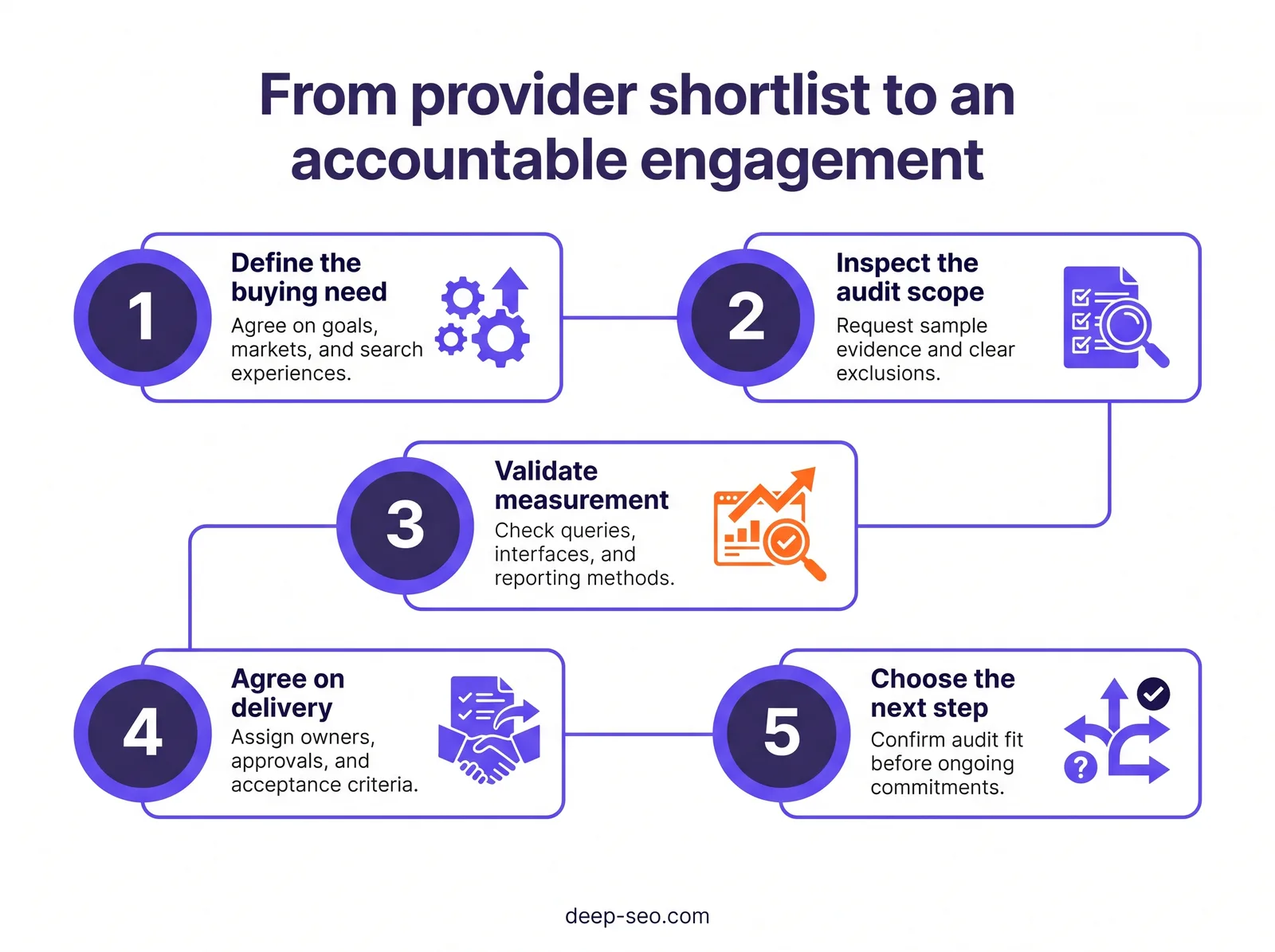
Before you buy a generative engine optimization service, ask what it measures and what you’ll receive. Find out who makes changes and how the provider tracks them. Compare scope and evidence, then check costs and ownership—not promises of AI citations or rankings.
Look closely at audits and technical claims; review case studies alongside pricing and contract terms. AI visibility, site visits, and sales need separate reports. Ask which systems the provider tests:
- Google AI Overviews
- Google AI Mode
- ChatGPT
- Gemini
Does it test an API or the app people use?
For background, read our guide to GEO and AEO. Use this checklist to compare proposals and decide whether you need an audit first.
What should a generative engine optimization service include?
A generative engine optimization service should assess where you stand and review your site, then turn those findings into priorities with a tracking plan. Every task needs a clear purpose and an owner. Ask the provider to spell out what it can and can’t control.

Treat this as a buying checklist, not an agency ranking. Generative engine optimization (GEO) and answer engine optimization (AEO) overlap: both describe work on visibility in AI answers. Providers don’t always use those labels the same way, so ask each to define its scope.
What work does the proposed scope actually cover?
Compare the work you’re buying, not the label on the proposal. Request a written scope covering:
- Baseline research: Identify key buyer questions and current brand mentions. Record linked sources and competing sites, and name the systems tested.
- Technical review: Check crawl access, indexing, and whether key pages can appear in search snippets.
- Content review: Check whether pages answer buyer questions and support their claims with evidence.
- Action plan: Rank tasks by value, effort, and what must happen first. Name who’ll make each change.
- Tracking: Define how you’ll track AI visibility and site visits, then specify how leads or sales will be measured. State what the tools can’t measure.
Ask where the scope overlaps with your current search engine optimization (SEO) work so you can spot duplicate fees and gaps.
Does Google require a separate technical approach?
No. A page must be indexed and eligible for a Google Search snippet to appear as a supporting link in AI Overviews or AI Mode. Google sets no extra technical rules for these features and requires no special AI files or schema markup, according to Google Search Central.
If a provider proposes structured data work, ask what it’s meant to do. They shouldn’t sell it as an AI-specific requirement, and meeting the rules doesn’t mean your page will appear.
What should an AI GEO / AEO audit deliver before you commit?
Before you commit, ask for an audit that names the systems and interfaces tested and includes the query set. You need dated evidence of your starting point. It should identify site issues and rank the tasks to address them, with a tracking plan. Each finding should support a decision.

Ask for evidence you can use
Ask for a sample with private client details removed. Every finding needs linked evidence and a proposed action, with an owner assigned. Your team should be able to use it without another call to explain it.
Keep the audit separate from the following, and ask which cost extra:
- Site changes
- New content
- Tracking
- Ongoing advice
Require system-specific eligibility checks
Use the Google eligibility checks described above.
OpenAI lets publishers allow OAI-SearchBot for search while blocking GPTBot for model training, so the audit should check these controls separately. According to OpenAI, changes to robots.txt can take approximately 24 hours to affect its search systems. That delay isn’t a deadline for citations or visibility.
Choose the engagement that fits your team
You can review Deep SEO’s audit offering against this checklist, but ask which deliverables it includes before buying.
The table below compares ways to buy the work; it doesn’t describe verified Deep SEO packages.
| What to compare | Audit first | Ongoing service | In-house work |
|---|---|---|---|
| Best fit | You need a baseline and plan | You need help doing and tracking the work | You have the skills and time |
| What to request | Evidence and ranked tasks | Clear tasks and regular reports | Owners, tools, and a work plan |
| Proof of delivery | Findings you can check and use | Work logs and progress reports | Finished tasks and repeatable tests |
| Who makes changes? | Check whether this costs extra | Split tasks between both teams | Name an owner for each task |
| Cost question | What does the fee leave out? | What renews or ends? | What staff time and tools are needed? |
Which technical claims should you challenge before buying?
Challenge any technical claim that blurs documented requirements with optional tests. Ask the provider why a change is needed and what evidence supports it before you approve the work. Broad crawler access or site changes need a clear reason, not just a recommendation.

Check Google’s documented requirements
Start with Google’s eligibility rules above, then ask the provider to distinguish requirements from optional tests.
For each optional test, ask for:
- Its purpose.
- The cost.
- The supporting evidence.
- The test method.
The proposal should spell out what would count as a useful result and when to stop testing.
Separate search access from training access
Use the separate OpenAI access controls described in the audit section.
Require controlled technical changes
Before you approve crawl or indexing changes, request:
- A change log naming the rules and pages affected, with a reason for each edit.
- A named approver and the checks to run before release.
- A plan to restore the old settings if something goes wrong.
Ask for proof that each change worked as intended, but don’t treat a successful site fix as proof that an AI system will select or cite the page.
Most of these claims come down to crawl and indexing basics, so a technical SEO audit first often settles them. Our AI search optimization services start from that baseline.
How will the provider measure AI visibility and business value?
Agree on a baseline and a test method your provider can repeat. Reports should show where the evidence came from and what changed against that baseline. Keep AI visibility separate from sales impact so you can see what’s being measured without confusing exposure with business value.

Keep visibility and business outcomes separate
- Brand mentions: Your name appears in an answer.
- Linked citations: An answer links to your site.
- Referral visits: Your analytics tool records visits from an AI source.
- Conversions: Your team records leads, purchases, or other agreed actions.
Don’t accept a score that blends these measures without explaining them.
Require reproducible evidence
For each test, record:
- The engine
- The interface or API
- The exact query
- The date
- The region
Note any known account settings that could affect the answer. Save screenshots or exports.
A September 2026 preprint studied 1,536 product-query responses. It compared the domains cited in API answers with those cited in consumer interfaces. Average overlap was 12.0% for ChatGPT and 14.8% for Gemini, according to the preprint.
The study also compared ChatGPT and Gemini consumer interfaces for the same queries. They shared 5.4% of cited domains on average. No domain was shared in 76.7% of comparisons, according to the same preprint.
These findings apply to the product queries tested, not all searches. They support testing each interface directly. Don’t treat API results as a stand-in for what users see, or results from one engine as proof of visibility in another.
Connect exposure to measured outcomes
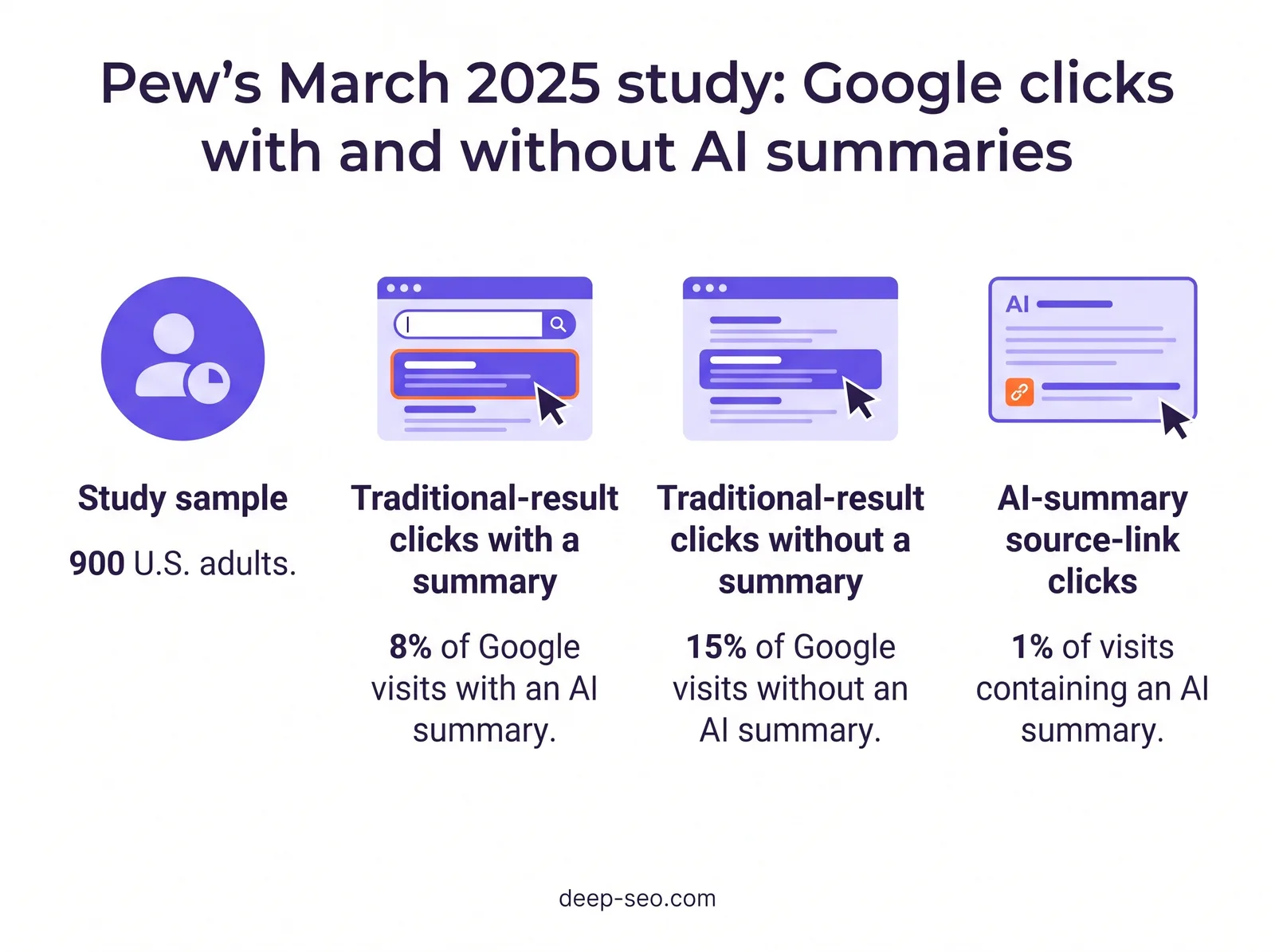
Pew Research Center studied browsing data from 900 U.S. adults in March 2025. Users clicked traditional search results on 8% of Google visits with an AI summary, compared with 15% without one, according to Pew.
In that same study, users clicked a source link in the AI summary on 1% of visits to pages with a summary, according to Pew. These findings describe that sample and setting. They don’t prove that AI summaries caused the click difference or that other audiences behave the same way.
AI referral traffic to U.S. retail sites grew 693.4% year over year during November–December 2025. The user base remained modest, according to Adobe. This is market context, not a growth target for your site.
An answer view isn’t a site visit, and a visit isn’t a sale. Ask how the provider links leads or sales to a traffic source. Reports should state tracking gaps and compare results with your baseline. A change after the work doesn’t, by itself, prove the work caused it.
Curious how your own site does? Run the free website check and RamradOS, our AI SEO assistant, picks it up from there. Start the free check →
What evidence makes a provider’s case study credible?
A credible case study gives you a fair before-and-after comparison, not just strong screenshots. You should be able to see what was tested and how success was defined, with a clear account of the changes made. The evidence shouldn’t overstate the provider’s role.

Check whether the comparison holds
Use the reporting method above to check the evidence. Look for:
- The queries tested before and after the work, with any changes explained.
- The engine and interface used for each test, along with its date.
- A record of the work completed and pages changed, with release dates attached.
- The full sample behind each success rate, including flat or weaker results.
Ask what was left out, because a rate based only on selected answers tells you little about the wider query set.
Keep engine and interface claims separate
Check the claims against the interface-specific evidence standard in the measurement section.
Distinguish context from proof
Ask whether any other work happened at the same time, such as:
- SEO changes
- Content updates
- Product launches
- Press coverage
Any of these can complicate the picture. A before-and-after gain alone doesn’t isolate the provider’s role.
Third-party research can help you judge a generative engine optimization service, but it doesn’t prove that a provider caused a client’s result. For that claim, you need evidence tied to the client’s work.
How should you compare pricing, scope, and contract terms?
Compare providers on the same scope, not just the headline price. Ask what each fee covers and what work stays with your team. Before you sign, agree on delivery terms and ownership rights, then check what happens when you need to end the contract.
Make quotes comparable
Give each provider the same brief so you can compare quotes. Ask which of these drives the price:
- Site size
- Content needs
- Markets
- Engines
- Tracking
- Site changes
- Reports
Get inclusions and exclusions in writing. Name who gives access and approves briefs, then who publishes changes and fixes blockers. Agree how delays or extra work affect fees and deadlines.
Match acceptance criteria to the purchase
Define what counts as complete before buying. The checks should match the work:
- Audit: Check the findings and priorities against the agreed audit checklist.
- Site changes: Check the finished work against the approved brief. Request test results and a change log.
- Ongoing service: Set regular tasks and review dates. Agree on reporting duties and how to handle unused time or new priorities.
If you need a baseline before buying implementation work, review Deep SEO’s audit offering. Ask whether later work needs a separate agreement.
Check ownership and exit terms
Clarify who owns each deliverable:
- Reports
- Query sets
- Evidence
- Briefs
- New content
Ask for export rights and files your team can use. Specify what access you’ll retain after the contract ends.
Ask whether outside contractors will do the work or access your data. List tool fees and who must approve extra spending.
Before signing, check:
- Renewal terms
- Notice periods
- Exit fees
- Handover support
List the files, accounts, and work records the provider must transfer. If a lower quote leaves more work with your team, make that trade-off explicit in the comparison.
Red flags to resolve before signing
These are warning signs, not claims about named agencies. Get written answers before you sign.

Promises and scores you can’t verify
Be wary of promises of certain AI citations or placement. Ask what the provider controls and what depends on outside systems.
For a custom score, ask for its inputs, method, and limits. You can’t judge it without knowing which engines and interfaces were tested. Ask for the test queries too.
Technical requirements without documentation
Check the requirements against the documentation checks in the technical section above.
Evidence stretched beyond its limits
Check the measurement section for interface and market-context limits. Revisit its causality limits too.
Implementation left unclear
Use the ownership and fee checks in the scope comparison above.
Your final buying checklist and audit-first next step
Put each generative engine optimization service proposal through this checklist. If anything is unclear, ask for a written answer before you sign.
A reusable buying checklist
- Scope: Which search systems does the proposal cover, and what work will you receive?
- Technical evidence: Does official guidance back the claims? Are optional tests clearly marked?
- Tracking: Can you repeat the tests? Check that reporting keeps these separate:
- Mentions
- Links
- Visits
- Sales
- Case studies: Does the evidence support the claim, with its limits made clear?
- Task owners: Who approves and publishes changes? Who checks them afterward, and what must your team do?
- Contract: Check that each of these is clear:
- Fees
- Exclusions
- Access needs
- Exit terms
- Handover duties
Mark each item as confirmed, unresolved, or out of scope, then keep the completed checklist with the proposal.
A short discovery-call script
- “Can you show us a sample audit?”
- “How do findings become tasks, and who owns them?”
- “Which engines and interfaces do you test?”
- “How do you keep test conditions consistent?”
- “What does the price leave out?”
- “If we stop, which files and unfinished tasks will you hand over?”
Decide whether an audit should come first
An audit makes sense if you’re missing a sound baseline or a ranked plan. It should give you a basis for deciding what to fund and what can wait, as well as what your team can handle in-house. If your current evidence already supports those decisions, you may not need a separate audit.
If you’re missing that baseline or plan, review Deep SEO’s AI GEO / AEO Audit. Confirm the current deliverables and access needs, then check the terms and whether it’s a fit.
For more background before you buy, visit the platform hub.
Before committing to ongoing work, agree on the starting point and next steps.
Frequently asked questions
Can a GEO provider work alongside my existing SEO agency?
Yes, but agree on roles first so you don’t get duplicate work or conflicting changes. Your SEO agency might handle site fixes and search planning, while the GEO provider studies AI answers and suggests content changes. Ask both teams to share findings and decide who approves site edits.
Does a multilingual website need separate GEO research for each language?
Plan research for each language and market rather than relying on translated prompts alone. You’ll need to check how local buyers ask questions and which sources AI answers cite. Have native-language reviewers check wording and facts, and test shared findings before applying the same plan in other markets.
Should legal or compliance teams approve GEO content in regulated industries?
Yes. Bring them in when content covers regulated claims or product fit, as well as risks or required notices. Agree on which topics need approval before writing starts. Short answers need review alongside full articles because they can lose context when quoted. Keep records of approved claims and sources, and put later edits through the same review process where needed.
Can existing articles be updated instead of commissioning entirely new content?
Yes. Start with pages that already address buyer questions, then update old claims and make the answers clearer. Add sources where needed, but don’t strip out useful detail just to rewrite for AI systems. New content makes sense when existing pages can’t cover a distinct topic well. Agree on priorities before you approve the work.
What should I do if an AI answer describes my brand inaccurately?
Save the details so you have a record:
- The prompt
- The answer
- The date
- The cited sources
Check whether the error comes from your site or another source. Fix content you control and request corrections elsewhere, then use the AI service’s feedback tools. Test the prompts again later, but don’t assume a site edit will change an AI answer right away.
Key takeaways
- Buy a clear scope, not a label. Check the provider against the checklist to see whether the scope fits your needs.
- Ask for evidence. Don’t rely on a provider’s claims until you’ve resolved gaps in its audit samples and case studies.
- Keep business value in view. Follow the measurement plan above; AI visibility isn’t revenue.
- Put roles and terms in writing. Confirm who owns the work and what the fees cover. Get exclusions and exit terms documented too.
Need a baseline or a ranked action plan? Consider a scoped AI GEO / AEO Audit from Deep SEO, but check the fit before buying. Use the findings to decide what work comes next.
See what this means for your website
Start with the free check. RamradOS explains the results and, if it fits, our AI GEO / AEO Audit goes deeper.
Check your website free — in one minute
Our AI platform reviews your site and shows what to fix first. Our SEO team can implement it for you.