

Updated October 28, 2026 · By RAMRAD · Reviewed by Robin Rad
Start by checking the scope of an SEO audit service and the evidence behind its recommendations. Before you hire anyone, be clear about who will act on the advice. Ask for a sample report and realistic estimates of possible gains, alongside an estimate of the work involved. You’ll need a plan for checking fixes, too. Choose a clear action plan over a long issue list, and reject providers that promise fixed rankings.
A useful audit gives you enough detail to make decisions: what needs work and why it matters, with a way for your team to check each fix. Google Search Central advises asking for realistic improvement estimates and an estimate of the work involved (Google Search Central).
Whether you need technical SEO audit services or a broader review, decide what access to give before work starts. Agree on who owns each task and how fixes will be tested, then use the same brief to compare bids. For more context, explore our SEO audit guides.
What should an SEO audit service include?
An audit should give you a diagnosis and an agreed action plan, not just access to a scan. The brief needs to cover technical health and content, with on-page elements and internal links included. Agree on a scope that fits your business needs before choosing a provider.

What will the audit cover?
Get the scope in writing and tie it to your business goals. Specify which parts of the site matter most: perhaps your product or service pages. If location pages matter to your business, name those too.
The scope should explain how the provider will check:
- Technical SEO: whether search engines can reach and index key pages, and whether canonical tags point to the right page versions.
- On-page elements: page titles, headings, and meta descriptions across key page layouts, or templates.
- Content: whether it meets search intent and helps potential customers. The review should look for useful gaps to fill as well as needless overlap.
- Internal links: how visitors and search engines reach key pages.
Be just as clear about what’s excluded. Before work starts, confirm whether international sites and separate subdomains are covered, and ask where archived content fits into the review.
How will the provider investigate?
Find out which pages the provider will crawl and which templates it will test. Sampling may be part of the approach; if it is, ask how the provider will choose the sample.
Request the data sources it plans to use, including Google Search Console where relevant, alongside an explanation of what a person will review beyond the automated checks.
A method needs a clear question behind it: can search engines access key pages? Do canonical tags point to the intended versions? Does the content meet the needs behind a search?
What should the diagnosis lead to?
Google Search Central recommends realistic improvement estimates and an estimate of the work involved in its SEO hiring guidance.
Ask how findings will become an agreed plan of work. You need to know which problems are proven and which still need checking, along with the assumptions behind each proposed action.
Before you hire, confirm that the provider will discuss priorities with your team rather than simply send a scan export.
Do you need technical SEO audit services or a broader review?
Choose technical SEO audit services when your main concern is how search engines access, render, or index your site. A broader review makes sense when content or search intent could explain weak results too. Start with the symptoms to decide what needs checking, but don’t treat them as proof of the cause.

Match the scope to the problem
Don’t rely on the service name to tell you what’s included. A technical scope should cover:
- Crawling
- Indexing
- Rendering
- Canonical tags
- Redirects
- Sitemaps
- Page performance
Ask the provider to confirm those checks and explain what evidence supports each finding.
If key pages are missing from search, a technical review is a sensible starting point. Google Search Console can help you identify those pages, though their absence doesn’t, by itself, prove a technical fault.
Unexplained traffic losses across groups of content may call for a broader review of content and search intent. Internal links need attention alongside the technical checks, too. Before you pay for changes, ask whether seasonal trends could explain the pattern.
Ask how the provider tests quality
Finding an element isn’t the same as checking that it works. Ask how the provider tests canonical targets and redirect destinations. You’ll also want to know how they check access to content after a page renders.
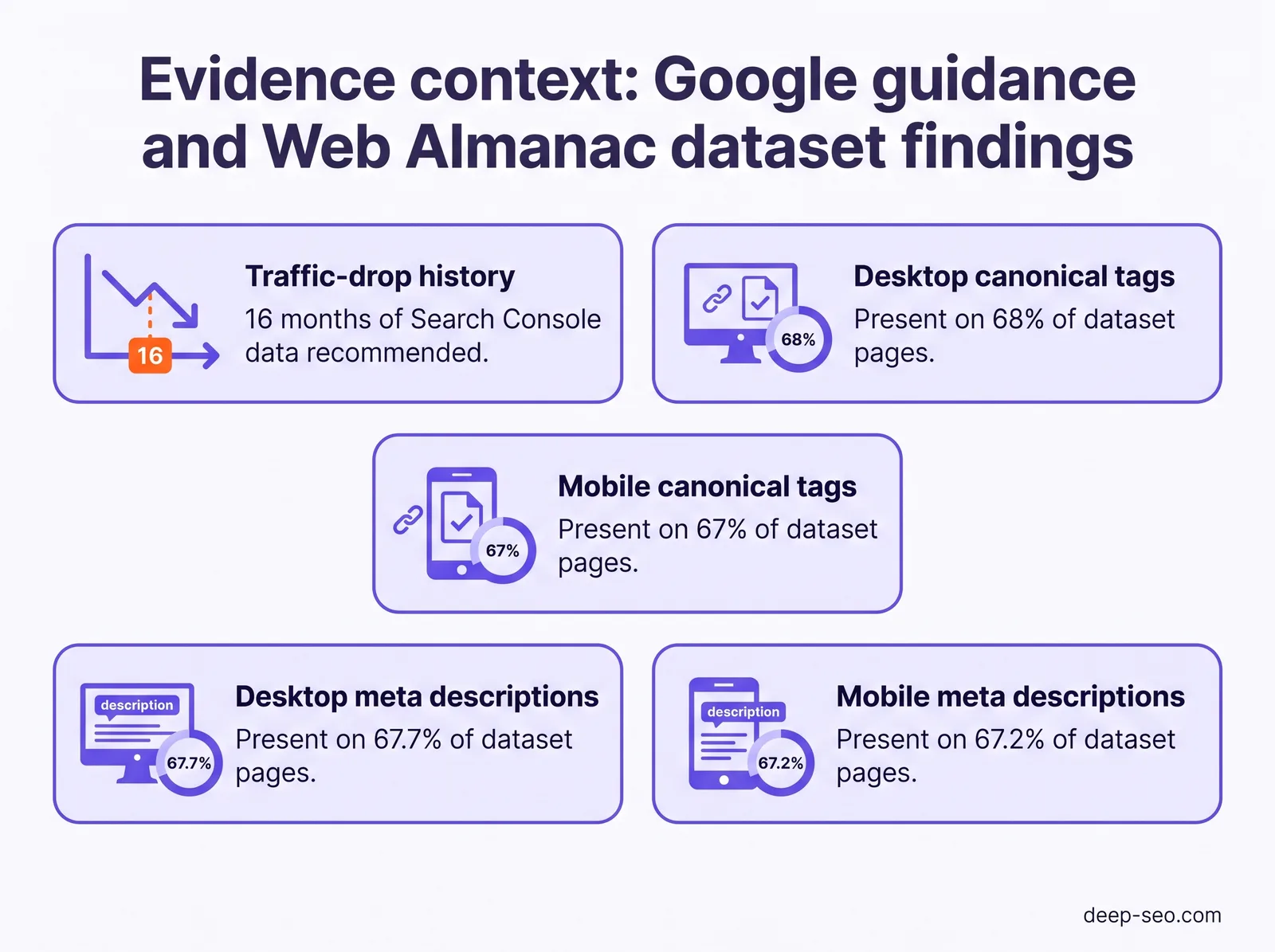
The 2025 Web Almanac found canonical tags on 68% of desktop pages and 67% of mobile pages in its dataset, according to HTTP Archive’s Web Almanac.
It found meta descriptions on 67.7% of desktop pages and 67.2% of mobile pages in the same dataset, according to HTTP Archive’s Web Almanac.
Those figures tell you how common the tags are, not whether they’re correct or describe your site. Ask how the provider checks for conflicting canonical signals and whether meta descriptions match each page.
When you review the AI SEO Audit offering, compare the listed checks with your brief. Ask Deep SEO what proof you’ll receive and which questions still need work.
If you also need to know how AI assistants describe your brand, use our GEO service buyer checklist alongside this guide. The two reviews can share one brief, so an AI SEO agency can scope them together.
What deliverables should you receive from an SEO audit?
Your seo audit service should give you a short summary and an evidence-backed issue list that identifies affected URLs or templates. You should also receive a ranked work plan, with a handoff detailed enough for the people making changes to understand each finding and know how to check the fix.

Make findings ready to implement
Ask for each finding to include these fields so your team knows what needs to change and why:
- Diagnosis: identify the problem and show the proof. Specify which pages or systems it affects.
- Action: describe the proposed fix and its expected benefit.
- Planning: give a work estimate and name the owner. Flag any tasks that must happen first.
- Validation: specify the tests that show whether the fix meets the agreed requirements. These are often called acceptance criteria.
Severity labels aren’t a work plan. Tasks need to be put in order, and the handoff needs enough detail for your team to act without having to work out what the provider meant.
Before you buy, ask to see a sample report with client details removed, along with an example work ticket.
Agree on estimates and delivery terms
Google Search Central advises asking for realistic improvement estimates and estimates of the work involved. Treat those as planning inputs, not promised outcomes.
Get the report formats written into the contract, including whether you’ll have access to the supporting data exports. The contract should cover the report walkthrough too, with clear terms for any help with questions after delivery.
Use these questions to compare audit formats rather than relying on a provider’s label, which doesn’t tell you what’s included.
| Buying criterion | Automated report: verify | Technical audit: verify | Broader audit service: verify |
|---|---|---|---|
| Coverage | Pages scanned and checks run | Systems, templates, and site areas checked | Technical, content, and other agreed areas covered |
| Evidence | Access to findings and affected URLs | How the provider confirms suspected faults | How findings answer your business questions |
| Human review | Whether an expert reviews the results | Who checks findings and related tasks | Who weighs findings from different parts of the review |
| Priorities | Whether issue labels become a plan of work | Whether work estimates and task order are clear | Whether priorities fit your goals and resources |
| Follow-through | Whether questions or rechecks are included | Whether work tickets and tests are included | Whether owners, handoff, and tracking are agreed |
How can you judge an SEO provider’s estimates and promises?
Judge a provider’s estimates by asking what supports them and where the uncertainty lies. Separate the audit deadline from the time needed to make changes; neither tells you when search performance might improve. You need evidence and clear limits, not promises of fixed search positions or recovery dates.

Check the reasoning behind each estimate
If an SEO promises the top position in search results, Google advises choosing another provider: Google Search Central. That’s a reason to walk away, not a claim you need to negotiate.
Estimates themselves aren’t the problem. Google says an audit should include realistic improvement estimates alongside an estimate of the work involved: Google Search Central.
Ask the provider to make the reasoning behind each estimate explicit:
- Assumptions: What needs to be true for the estimate to hold?
- Dependencies: Will you need developer time or content changes? Are approvals required?
- Unknowns: What’s still unclear, and how could that affect the outcome?
- Reasoning: Which findings support the expected gain?
Separate delivery dates from potential impact
An SEO audit service should distinguish audit delivery from implementation effort in its proposal. The first tells you when you’ll receive the agreed findings; the second sets out the work needed to make the proposed changes.
Potential search impact is a separate estimate: what might improve, and how much confidence the provider can reasonably place in that assessment. A report deadline doesn’t predict when search results will change, so ask which dates the provider controls and which depend on others.
Require evidence before accepting a diagnosis
If your traffic has dropped, ask whether the provider will review 16 months of Google Search Console performance data. Google recommends this window to help distinguish problems from recurring seasonal patterns: Google Search Central.
Don’t read that window as a recovery timeline. A seasonal trend may explain the change, but the provider still needs to test that explanation against the evidence before naming a cause. The findings shouldn’t be bent to fit a diagnosis made during an early sales pitch.
Curious how your own site does? Run the free website check and RamradOS, our AI SEO assistant, picks it up from there. Start the free check →
What access should you give an SEO audit provider?
Give your provider access to assess the site, not permission to change it. Google’s audit-stage hiring guidance recommends granting only read access to Google Search Console, as stated by Google Search Central. Record why each request is needed. Agree on any rights to make changes as a separate step.

Create a written access inventory
Before you share access, ask the provider to list every account it needs. Include any datasets and specify the exports or logs requested. Each entry should explain:
- Purpose: Which audit question will this help answer?
- Scope: Which site or property does it cover? Specify the date range and site area.
- Permission: What access level is needed? Could an export serve the same purpose?
- Owner: Who approves access, and who removes it when the work ends?
Keep access for diagnosis separate from rights to make changes. An audit request shouldn’t grant permission to edit content or change settings. Permission to publish code is separate, too. If the provider later makes fixes, agree on those rights separately, with named approvers and a clear scope.
Agree how confidential data will be handled
To protect your data, ask who can view it and where it’ll be stored. Check whether outside contractors or tools will receive any of it.
Put your requirements for handling private data in writing. Specify when access must be removed and whether exports and logs should be kept or deleted. Ask whether you can remove sensitive fields before sharing. These are your buying conditions, not Google’s stated audit rules.
Make access limits visible in the findings
Google recommends reviewing 16 months of Search Console performance data when looking into traffic drops because that helps separate problems from recurring seasonal patterns, according to Google Search Central.
If past data is missing, the report should state which period is available and which conclusions remain unclear. Apply the same rule to site areas the provider can’t access. Ask it to record what it couldn’t test and how that limits the findings. The report should identify what evidence would fill the gap.
Who implements the recommendations and validates the fixes?
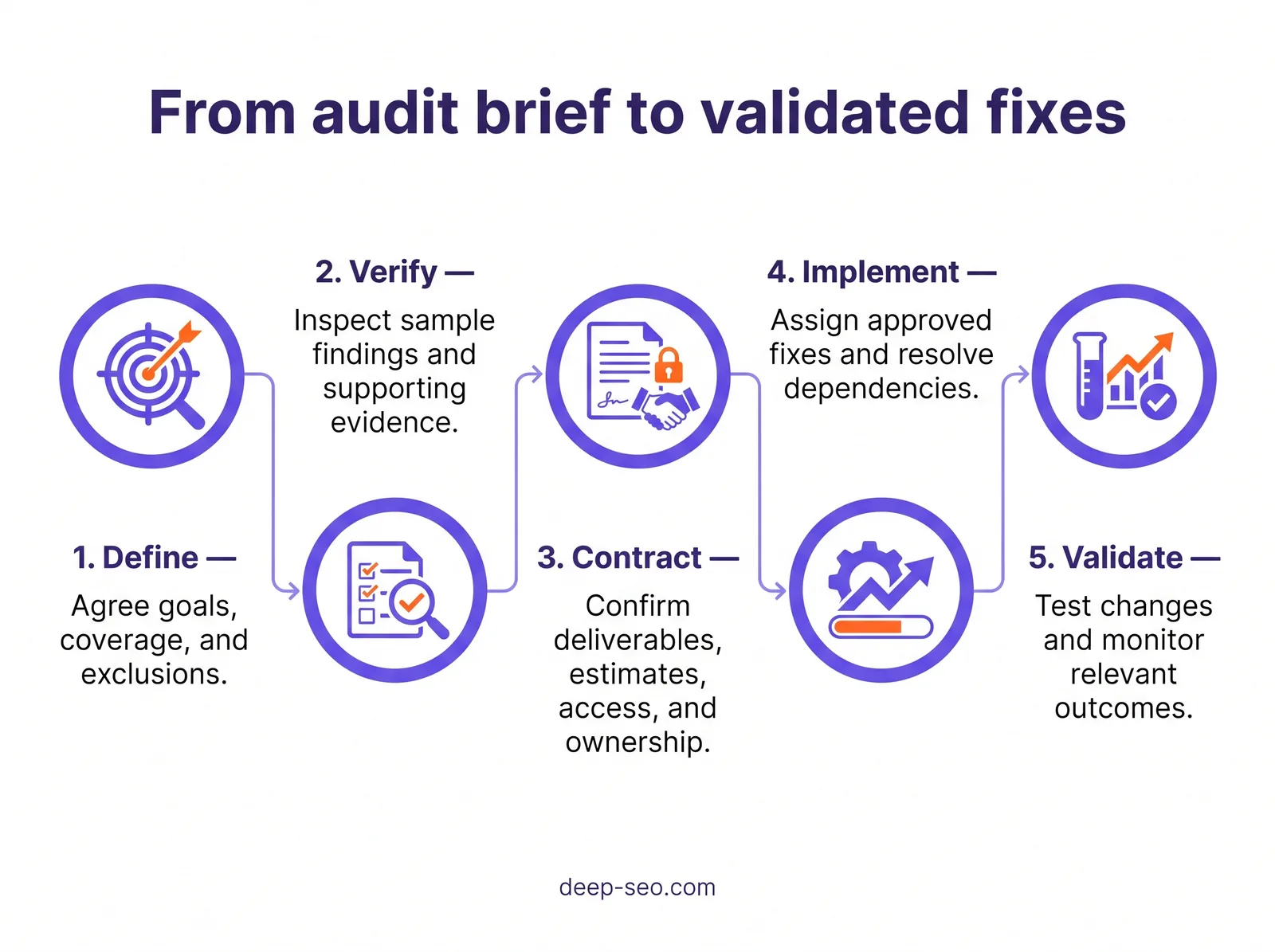
Implementation may sit with your team or the audit provider; a separate partner is another option, depending on the contract. Before work starts, assign someone to do the work and someone to check it. Agree who approves each fix, tests affected pages and signs it off. Don’t assume implementation is included.

Confirm the delivery model
Check how much help your seo audit service includes. The contract should make the delivery model clear:
- Recommendations only: Your team gets the findings and takes responsibility for making the changes. Testing is your team’s job too.
- Implementation support: Your team does the work, with the provider answering questions or reviewing proposed changes.
- Hands-on implementation: The provider makes agreed changes within a defined scope and approval process.
When you review the AI SEO Audit offering, compare the delivery terms with what your team needs. Ask who handles anything outside the agreed scope.
Assign ownership and acceptance criteria
Give each approved task a named owner and a named person to sign it off. Record any tasks it depends on, then define the test it’ll need to pass. Department names aren’t enough.
A canonical tag fix, for example, may depend on a template release. Its acceptance test could check that affected pages show the intended tag without conflicting output.
Follow each fix through a clear process:
- Check the finding against the site as it is now.
- Approve the proposed fix and its scope.
- Make the change through the agreed release process.
- Test affected pages or templates against the agreed criteria.
- Track relevant outcomes and record open questions.
Separate validation from impact
A technical test checks whether the change works as intended; search and business tracking show what happened afterward. Neither alone proves cause and effect, because content changes or seasonal trends may affect results too. Other releases can also influence what you see.
Get the support period and recheck scope in writing, along with handoff terms and any extra fees. Specify whether rechecks cover every affected template or an agreed sample. Decide where test evidence will be stored and who receives it, then agree how failed tests go back onto the work list.
Compare SEO audit services using the same brief
Give each shortlisted provider the same brief before you compare prices. You’ll find it easier to spot where SEO audit services differ when they’re responding to the same requirements.

Make the brief specific enough for providers to scope the work. Include:
- Your site’s size and structure, with its key templates.
- The markets and subdomains the audit needs to cover.
- Your goals and the symptoms you’ve noticed.
- The data available to the provider.
- Your resources for making fixes, including limits on developer time or content support.
- Any constraints imposed by release schedules.
Ask each provider to base its proposal on that brief, and keep the core requirements unchanged so you can compare responses fairly.
Compare commitments, not report length
Use a shared comparison sheet to mark each requirement as confirmed, excluded, or unclear, with the provider’s explanation beside it. A vague answer stays unclear until the provider resolves it in writing.
- Coverage: Does the proposal address each part of your brief?
- Evidence quality: Does the sample tie its findings to the site under review?
- Priorities: Does the provider explain how it will rank the work?
- Work estimates: Are the assumptions and effort needed clear?
- Access needs: Do the requested rights fit the audit-stage limits discussed earlier?
- Follow-through: Does the contract define the handoff? Is support for questions and help with tests included?
Check estimates against Google Search Central’s guidance, which calls for realistic improvement estimates and an estimate of the work involved. Reject promises of the top search position, as Google Search Central advises.
Resolve exclusions before comparing cost
Ask providers to distinguish what’s included in the contract from optional work. Get exclusions explained, too, and check whether follow-up support costs extra. A narrower quote may fit your needs, but you’re not buying the same coverage as you would with a broader one.
A longer report isn’t stronger proof, nor are more automated checks. Compare what each provider commits to check and deliver instead.
Assess Deep SEO’s AI SEO Audit against the same brief, confirming its current scope and outputs directly. Record any gaps before you hire.
Your final checklist before commissioning an audit
Before you commit to a seo audit service, compare the proposal with what you’ve agreed. If something’s missing or unclear, get it settled before you sign.

- Business question: Does the brief name the decision you need the audit to support, or does it just ask for an SEO review?
- Site coverage: Check that the scope covers the relevant parts of your site and matches the business question:
- Domains
- Subdomains
- Templates
- Markets
- Content areas
- Exclusions: Is it clear what the provider won’t check or deliver? Does the proposal say what they won’t change?
- Sample deliverables: Have you seen a sample detailed enough for your team to act on? Confirm that your package includes the same depth of work.
- Estimates: Are the assumptions and unknowns written down, along with the likely effort? Keep delivery dates separate from possible search outcomes.
- Access: Does the proposal list the systems and access rights needed? Google Search Console access should stay read-only at the audit stage.
- Work owners: Has someone accepted each area of work, and are the costs of making fixes included in the proposal or separate?
- Validation: Who checks completed fixes, and which tests will they use? Ask how unresolved issues get back into the work plan.
The estimate and access checks follow Google Search Central guidance: request realistic improvement estimates, work estimates, and read-only Search Console access.
Don’t confuse a realistic estimate with a promise of a fixed ranking. If a provider promises the top search position, choose another provider, as Google Search Central advises.
Settle unclear roles before signing and put agreed changes into the proposal. The final report shouldn’t be where you discover the scope after the work is done.
If you’re assessing Deep SEO, review its AI SEO Audit against your brief and confirm that the written scope fits. The Deep SEO audit hub offers more background to help you ask sharper questions, but you’ll still need to check the scope itself.
Frequently asked questions
How often should you commission another SEO audit?
Base your review schedule on what’s changing on your site and which issues remain unresolved. Ask the provider how those risks and your planned work should affect the timing. Major site changes or ongoing search declines may call for a fresh audit; between audits, keep tracking key issues and testing completed fixes.
Should you audit a website before or after a migration?
You need checks on both sides of a migration. Before launch, ask the auditor to review:
- URL mapping
- Redirects
- Internal links
- Indexing controls
- The staging site
After launch, test those changes on the live site, with follow-up tracking included in the scope. Agree who’ll fix problems and check that key pages stay accessible.
What extra scope should a multilingual website request?
Ask the auditor to review each language section separately, with checks for:
- Language and regional targeting
- Hreflang tags
- Canonical tags
- Links between translated pages
Each section needs an indexing and navigation review, plus an assessment of local search intent. Include language switching and automatic redirects in the scope. You should be able to distinguish technical faults from translation or content gaps in the report, with clear actions for each.
What should an ecommerce audit examine about product variants and filters?
Start by asking how variants and filters create URLs, then clarify which pages should appear in search. The scope should cover:
- Canonical tags
- Internal links
- Crawl access
- Indexing controls
- Sitemaps
Request checks for duplicate product content and useful filtered pages too. You need advice that explains the trade-offs, rather than simply recommending that you block every filter or merge every variant.
Can an SEO audit also assess visibility in AI-generated answers?
Yes, provided the scope explicitly includes it. Ask which relevant questions will be tested and on which named AI platforms. You should get a record of brand mentions and cited pages, but treat it as a snapshot because answers can vary. Keep the review separate from standard search reports and ask for practical advice. Mentions alone aren’t proof of visits or sales.
Key takeaways
- Start with your business questions. The right SEO audit service answers those questions rather than just handing you a long report. Judge providers against the scope you’ve agreed.
- Ask for evidence you can use. Your team should be able to see what needs work and why it matters. Findings should be clear enough to judge what can wait.
- Check the assumptions before signing. Possible search gains are estimates, not promises, so check the provider’s reasoning. Make sure the work fits your resources, too.
- Agree on delivery before you buy. Confirm who will make the changes and who will check them, because an audit has limited value if nobody can act on it.
Before you commission the audit, ask your preferred provider to resolve any gaps in the proposal.
See what this means for your website
Start with the free check. RamradOS explains the results and, if it fits, our AI SEO Audit goes deeper.
Check your website free — in one minute
Our AI platform reviews your site and shows what to fix first. Our SEO team can implement it for you.