
Updated November 11, 2026 · By RAMRAD · Reviewed by Robin Rad
Deep SEO combines a measured website health check with one-off reports, turning site data into prioritised findings. The AI interprets evidence rather than inventing scores. Reports make testing limits clear. Before any website changes, you need to connect your site and approve each change. Rollback is available, but Deep SEO doesn’t promise rankings.
How does Deep SEO work in practice? You start with the free check on the AI SEO Platform. It runs a real Google PageSpeed test and reads your homepage to score:
- Speed
- SEO
- Content
- AI-search visibility
Those findings, together with your goal, shape the service recommendation.
For a paid report, Deep SEO gathers site data for AI analysis, then checks the findings against the evidence. You get the report in your account and as an emailed PDF. A report identifies findings and testing limits—it isn’t permission to change your site. Applying changes requires your approval. The agency team also handles implementation work.
What does the Deep SEO free website check measure?
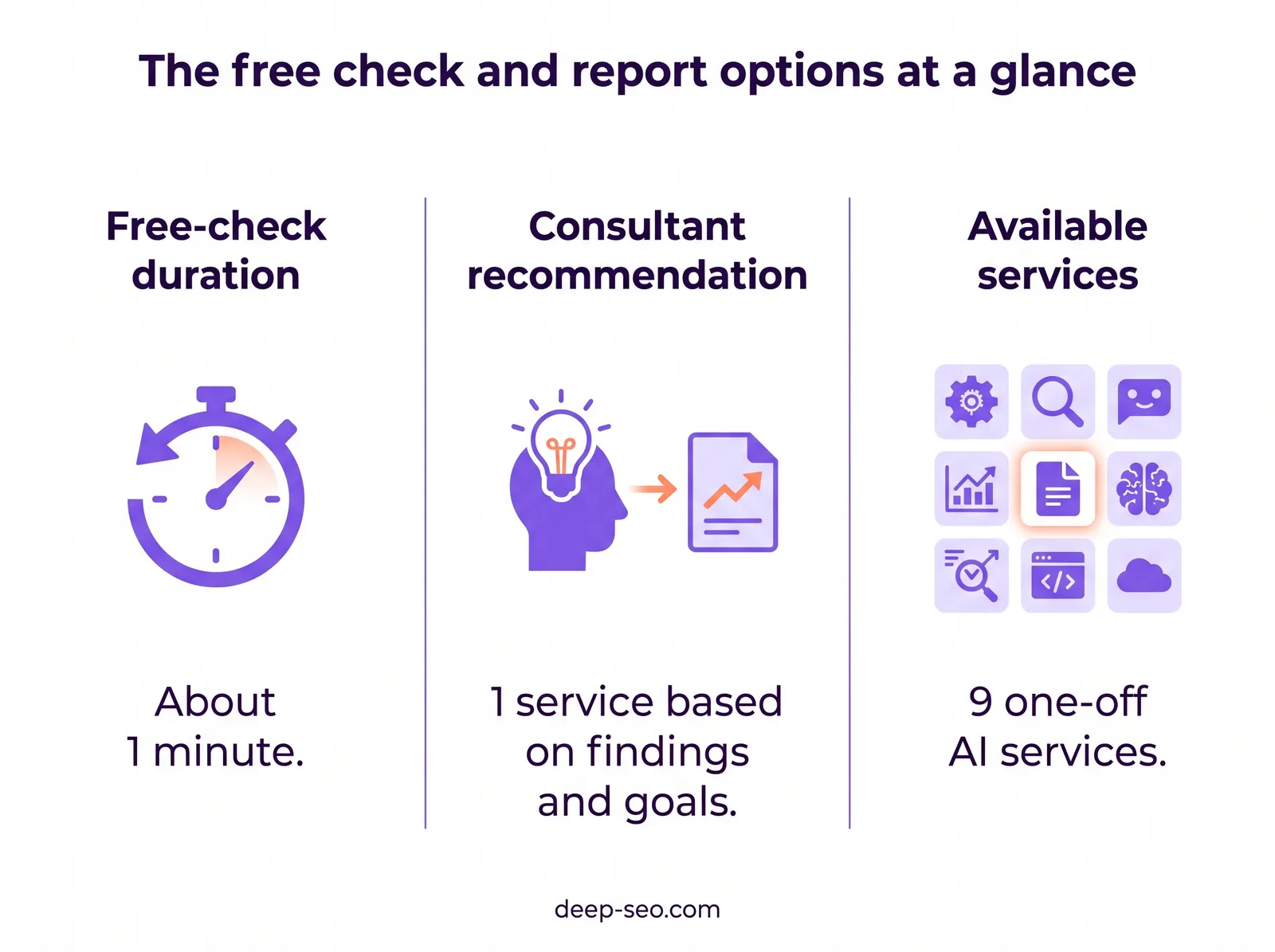
The Deep SEO free website check measures your homepage’s speed and SEO, along with its content and AI-search visibility. It uses a real Google PageSpeed test and a reading of your homepage to give you an initial website health assessment in about a minute. It isn’t a full-site crawl.
Enter your website address in the chat on the AI SEO Platform to start the free check. The platform gathers the measurements it needs to calculate your scores, but the scope stays narrow: it’s checking your homepage. Read the findings as an assessment of that page rather than your whole website.
A homepage score doesn’t tell you how every other page is doing, and the AI-search visibility score isn’t a recorded AI mention test. You can use the free check to answer questions within those limits. If you need answers about the rest of your site, you’ll need a separate audit.
Accessing the findings
You can see the full list of findings behind the initial assessment by signing in with an e-mail code—there’s no password to create. That gives you access to the list, not a broader assessment. The findings still cover your homepage; signing in doesn’t turn the check into a full-site crawl.
The consultant recommends one service after considering the findings alongside your goal. Your homepage’s measured condition is part of that decision, but what you want to address in your business matters too. The service isn’t selected in advance of the measurements. The recommendation starts with what the free check actually found, then takes your goal into account rather than relying on the homepage measurements alone.
At this stage, you have the findings and a service recommendation, not a full report. A paid report is a separate choice; it isn’t included in the free check.
Choosing a one-off report from nine services
Once you’ve had the free check, you can order a one-off report through the Deep SEO platform, with a quote provided in the chat. You don’t need a subscription or retainer. The services are listed on its platform page:

- AI SEO Audit — crawls your site in full to find technical and on-page issues, showing which pages they affect. A published priority formula is included.
- AI Core Web Vitals Audit — shows Google speed measurements, explains what’s causing them and provides a prioritised fix list.
- AI Core Web Vitals Optimization — applies approved changes to WordPress. You’ll receive a before-and-after report and have one-click rollback available.
- AI Keyword Planning — supports keyword planning for your website.
- Competitor analysis — analyses your competitors.
- the AI GEO / AEO Audit — pairs a recorded AI mention test with audits of entities and structured data.
- AI Content Engine — provides a content calendar with ready-to-write article briefs.
- Google Business Profile Setup Pack — provides the materials for a new Google Maps listing, including the official verification steps.
- Google Business Profile & Maps Audit — examines the public appearance of your listing.
Start with the question you need answered rather than treating these reports as interchangeable. Each scope covers a different task; you can check the details in Deep SEO’s service descriptions and the service overview.
Before you order, make sure that task matches what you need now. Investigating why pages are slow is different from applying WordPress fixes, so check which of those you’re asking for. For Maps, the distinction is between preparing a new listing and examining how an existing listing appears publicly.
How does Deep SEO turn site data into a report?
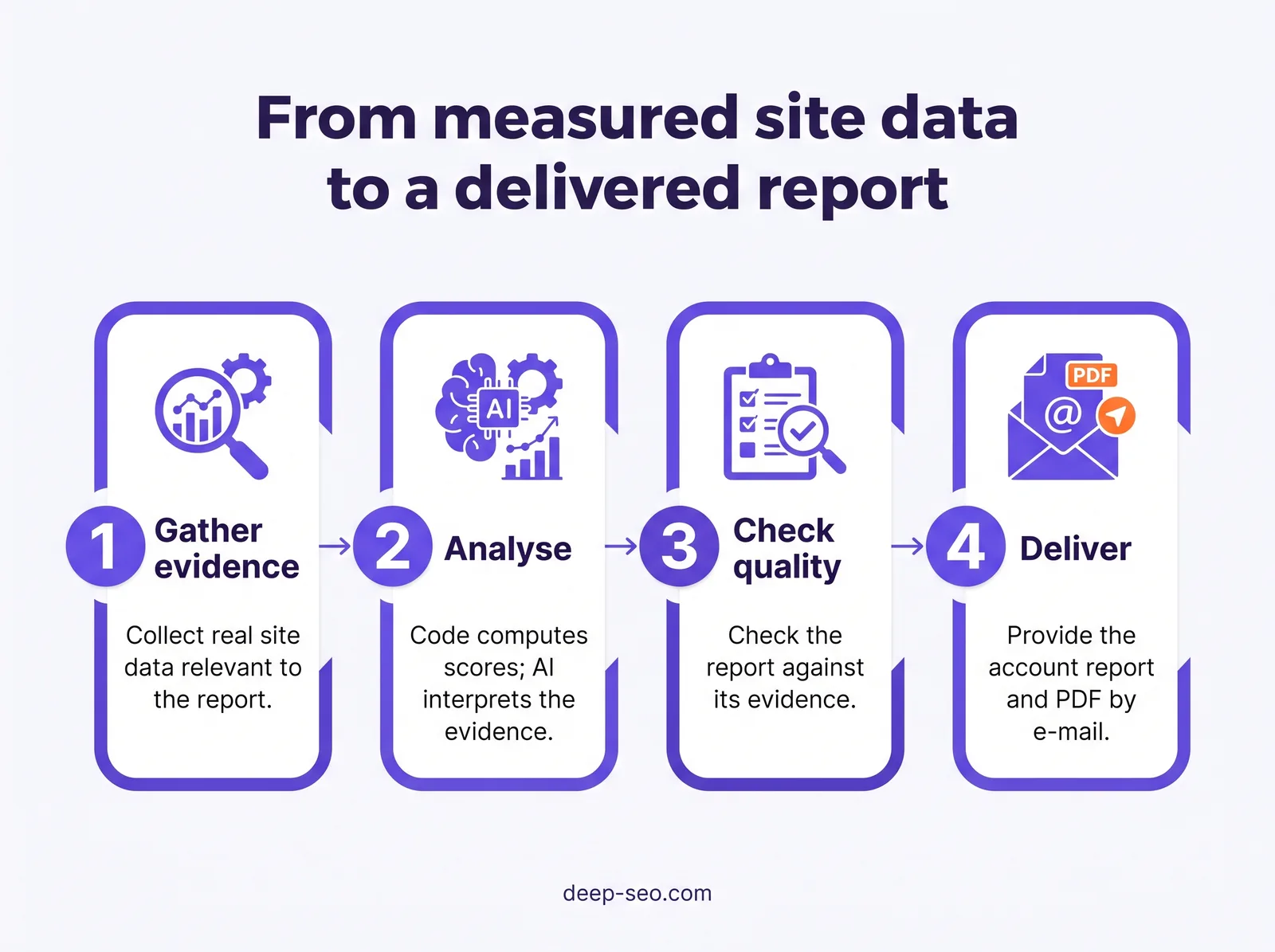
Deep SEO turns site data into a report by measuring the evidence first, then explaining it. Code calculates the scores; Deep SEO AI interprets those numbers rather than making them up. Before a paid report reaches you, a quality check compares it with the underlying evidence, so the findings don’t rest on AI output alone.

From site evidence to delivery
- Gather the evidence. What Deep SEO collects depends on the service, because each report needs evidence that fits the work it’s doing. That can include:
- Google PageSpeed measurements
- a crawl of the site’s pages
- public Maps data
- recorded AI answers
- Explain the numbers. AI doesn’t decide your scores. Code calculates them, and every scoring formula appears in the report so you can follow how each number was reached. AI’s role is to explain what those calculated scores mean.
- Review against the evidence. A reviewer checks each paid report against the evidence behind it. That’s not the same as independently verifying every statement: facts that only you can confirm remain marked as needing your confirmation.
- Put the report in your hands. You’ll find the finished report in your account and receive a PDF by e-mail. Both give you a way to discuss the findings with your team; choose the format that suits you.
What the quality check means
There’s a distinction between a measured score and an interpretation. A score is the result of a calculation using real data. An interpretation explains what the evidence suggests, but writing it into a report doesn’t make an untested claim a verified fact.
Before you act on a finding, you need to know how much has actually been checked. Reports make that visible by spelling out what’s been tested and what hasn’t, including anything that couldn’t be verified at all. You can read Deep SEO’s description of this reporting process on the AI SEO Platform.
What does a delivered report contain—and leave unverified?
A delivered Deep SEO report gives you measured findings and code-computed scores, with every scoring formula printed. Interpretation is kept separate from the evidence, as are service-specific recommendations. You’ll see which checks were performed and which weren’t. Anything that couldn’t be verified stays explicit; owner-only facts are marked for your confirmation.

Evidence depends on the selected report
The service you choose determines which evidence appears in your report. Sources can include:
- Google PageSpeed measurements
- Page crawls
- Public Maps data
- Recorded AI answers
Not every report uses all of these sources. For example, the AI GEO / AEO Audit includes a recorded AI mention test alongside audits of entities and structured data. Those checks answer different questions from speed measurements or checks of how a listing appears publicly in Google Maps.
You can examine the basis for each score because the report prints every scoring formula. You’re not being asked to accept an unexplained AI judgment. When you read a finding, distinguish the measurement from the interpretation: one is evidence, while the other explains it. A recommendation is a proposed action for that service, not another measured finding.
Untested and unverified details stay explicit
Before you decide what to change, check the scope of the work. The report identifies what it tested and what it left untested. Information it couldn’t verify is flagged separately, so you can distinguish it from a confirmed finding.
Some facts can only be confirmed by the owner, and those stay marked for your confirmation. If a recommendation relies on one, confirm that fact before you use the recommendation to make a decision.
Deep SEO doesn’t promise rankings. The report can explain measured issues and suggest changes; it can’t establish something as fact if it hasn’t been measured or verified. Check the supporting evidence for each recommendation, including any stated limits.
Curious how your own site does? Run the free website check and RamradOS, our AI SEO assistant, picks it up from there. Start the free check →
How are changes approved, and where does the team help?
You stay in control: Deep SEO can only make changes after you connect your site and approve each change, and you can roll anything back. Getting a free check or buying a report doesn’t give Deep SEO editing rights. If you need implementation help, there’s a separate agency team.

That team’s services go beyond the platform. Deep SEO lists the following areas of work:
- AI search optimization
- Technical SEO
- On-page and off-page SEO
- Content marketing
- Local SEO
- E-commerce and website infrastructure
Decide whether you want the report separately from whether you want help implementing it. A report purchase doesn’t automatically cover the services above, and automated changes aren’t the right fit for every website.
Which languages and regions does Deep SEO serve?
If you’re based in Europe or the Middle East, you’re in the regions Deep SEO serves. The site and service are in English, according to Deep SEO.
Who operates Deep SEO?
Deep SEO’s company page names Mehdi Ramezani Trade as the operator, based in Muscat, Oman, under CR 1642454.
How experienced is the team?
According to Deep SEO, the team has a track record of over 20 years. That experience comes mainly from website design and SEO work.
How can you access the full free-check findings?
You’ll need to sign in to see the full findings, but you don’t need a password. Access uses an e-mail code, as explained on the AI SEO Platform.
Does the agency support Amazon SEO?
Yes. Deep SEO lists Amazon SEO among the agency team’s services, but don’t assume it’s included with every report. It’s agency support rather than a standard report inclusion.
For a look at the reports and the controls for site changes, you can explore the AI SEO Platform.
Read more
Frequently asked questions
Which language and regions does Deep SEO serve?
Deep SEO’s site and service are in English, with businesses in Europe and the Middle East as the intended audience. You can get a free health check by entering your website address in the platform’s chat. The check combines an AI audit with access to an agency team that can carry out the work, rather than leaving you with findings alone.
Who operates Deep SEO?
The Deep SEO company page lists the operator as Mehdi Ramezani Trade, CR 1642454, based in Muscat, Sultanate of Oman. It’s an SEO agency with its own AI platform: you can get an audit and have the team implement the SEO work.
How much experience does the Deep SEO team have?
The team has over 20 years of experience, according to the Deep SEO company page. That background covers:
- website design
- SEO
- web marketing
- content creation
Don’t read that figure as the platform’s age; it refers to the team’s experience. You can use the platform independently for audits and plans, then bring in agency support if you need help putting them into practice.
Does accessing the full free-check findings require a password?
No. You sign in with an e-mail code to see the full list of free-check findings, so there’s no password to enter. During the check, the platform runs a real Google PageSpeed test and reads your homepage. The consultant can then recommend a service based on those findings and what you’re trying to achieve.
Can the Deep SEO agency team also help with Amazon SEO?
Yes. The Deep SEO agency team’s work covers:
- Amazon SEO
- e-commerce SEO
- content marketing
- website infrastructure
For Amazon help, ask about agency support directly. The team’s scope is broader than the platform’s reports, which focus on areas such as website audits and keyword planning.
Key takeaways
- Your Deep SEO report tells you what the audit tested and what couldn’t be verified. Owner-only facts stay marked for confirmation rather than being presented as established evidence.
- A reviewer checks each paid report against its evidence. You’ll get the report in your account and a PDF by email.
- If you need help with implementation, the agency team can work across:
- technical SEO
- content
- local search
- e-commerce
- website infrastructure
Deep SEO doesn’t promise rankings.
- The site and service are in English and serve businesses in Europe and the Middle East. Your goals help you decide which findings to act on.
Take the free check’s findings and your business goal to the chat to discuss which report fits.
See what this means for your website
Start with the free check. RamradOS explains the results and, if it fits, our AI GEO / AEO Audit goes deeper.
Check your website free — in one minute
Our AI platform reviews your site and shows what to fix first. Our SEO team can implement it for you.