
Quick answer: Keyword types are overlapping categories used to describe search queries by demand, brand association and geographic relevance. Head keywords sit at the high-demand end of a market; long-tail keywords have lower individual demand. Branded queries reference an identifiable brand, while local queries seek geographically relevant results. One query can belong to several categories.
Key facts
- Branded queries can include misspellings and uniquely associated products, even without the brand name. Introducing the branded queries filter in Search Console
- As of March 11, 2026, Search Console’s branded queries filter is available to all eligible sites. Introducing the branded queries filter in Search Console
- Google can match relevant pages to queries without every exact keyword variation appearing on the page. Search Engine Optimization (SEO) Starter Guide
TL;DR: Classify each query separately by demand, brand association and local relevance, then evaluate its business value rather than relying on word count or assumed conversion rates.
- Head keyword
- A query at the high-demand end of a market’s search-demand distribution, often broad and short but not defined by word count.
- Long-tail keyword
- A query in the lower-demand tail of a market’s search-demand distribution, often specific but not necessarily long.
- Branded keyword
- A query referring to a particular brand through its name, a variation or a uniquely associated product or service.
- Local keyword
- A query seeking geographically relevant results, with location expressed explicitly or inferred from context.
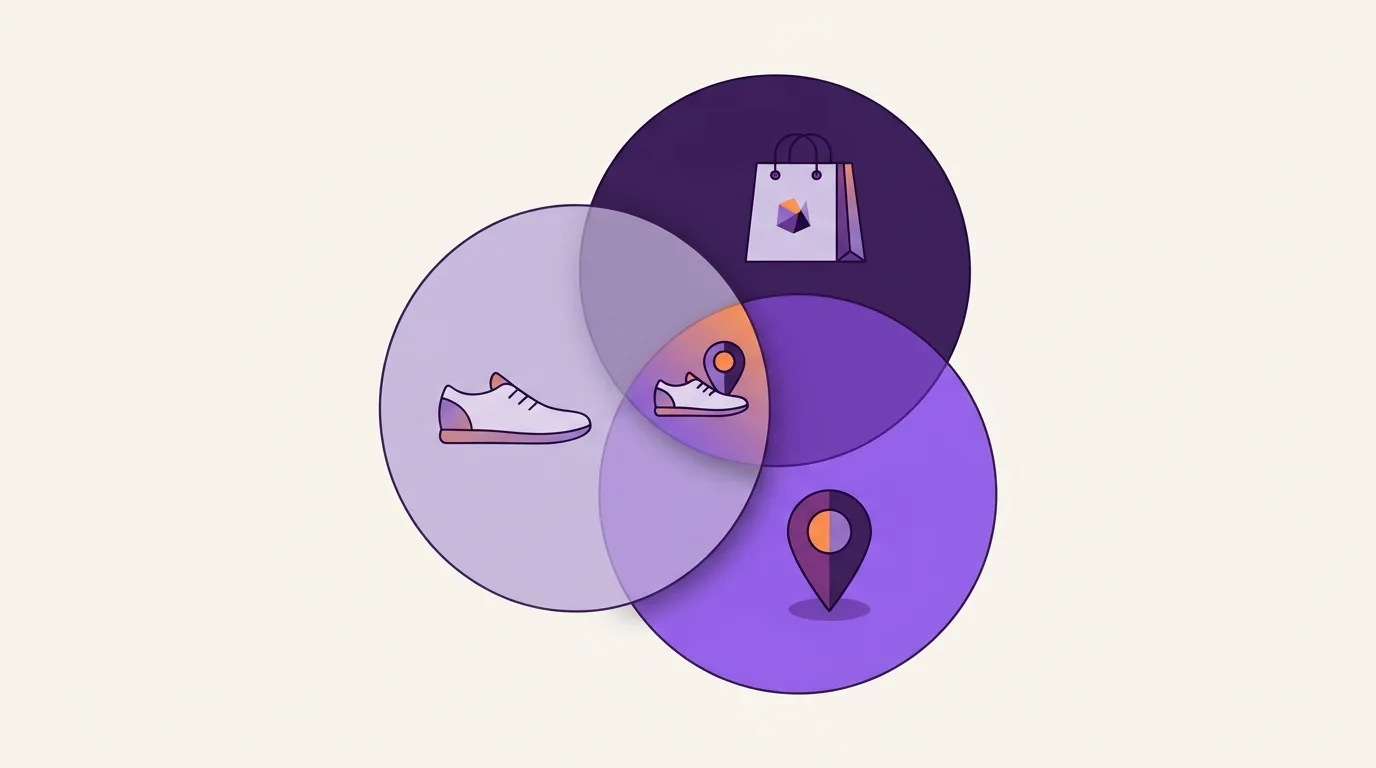
What are keyword types in SEO?
Keyword types are overlapping labels that describe queries by search demand, brand association and geographic relevance. Head keywords have high demand within a market; long-tail keywords have lower individual demand. Branded queries identify a brand, while local queries seek nearby or place-specific results. A query can carry several labels.
These dimensions form a practical classification framework, not an official Google ranking taxonomy.
| Dimension | Labels | Illustrative example |
|---|---|---|
| Demand | Head keywords; long-tail keywords | “shoes” is broad, but its demand needs evidence. |
| Brand association | Branded queries; non-branded queries; competitor-brand queries | “Nike running shoes” names a brand; “running shoes” does not. |
| Geographic relevance | Local intent with explicit or implicit location | “shoes near me” states a local need; “shoe repair” may imply one. |
Short-tail keywords describe brief wording; head and long-tail labels describe a query’s position in the search-demand distribution, not its word count.
“Nike running shoes near me” is both branded and local. Its head or long-tail status requires demand evidence.
Keyword type classifies a query, while search intent describes what the searcher wants to achieve.
Why keyword types matter for SEO decisions
This section explains how keyword classification supports SEO decisions and helps you interpret search performance.
Separate broad reach, specific needs, existing brand demand and geographically relevant demand when comparing opportunities:
- Broad demand: Head keywords can reach a wider audience, but competition and intent need validation.
- Specific needs: More detailed queries can reveal a distinct problem or requirement; check demand rather than assuming they are long-tail.
- Brand demand: Branded queries help distinguish people seeking a known brand from non-branded discovery.
- Geographic demand: Local queries help assess whether searchers need results in places you serve.
Pooled performance can hide these differences. Growth in branded searches may reflect stronger awareness, not broader non-branded discovery. Report those trends separately before judging progress.
Treat keyword type as context, not a priority score. Long-tail keywords do not automatically convert better, and head keywords do not necessarily have weak intent. Relevance, observed results and business outcomes determine value.
Keyword research helps you find and assess queries within these groups.
An overall SEO strategy connects those opportunities to business goals and resource choices.
How do head and long-tail keywords differ?
Head keywords and long-tail keywords differ by their relative position in the search-demand distribution, not by a fixed word count. Head terms have high demand within a market, while long-tail terms have lower individual query demand. “Short-tail” commonly refers to head terms, regardless of their exact length.
For illustration, “shoes” is broad, while “running shoes for narrow feet on wet trails” expresses a specific need. These examples show breadth versus specificity; they are not measured demand classifications. Here, “broad” describes the query’s scope, not a paid-search match setting.
A short niche term can belong to the long tail. A longer, popular phrase can still attract substantial demand. Specific wording alone does not prove low demand, and low demand does not mean easy rankings.
Assess relative demand within a consistent market, language and time period so your comparisons use the same frame. There is no universal search-volume cutoff between head and long-tail keywords. Use measured demand rather than phrase length to assign the label.
For tool selection and ways to estimate search volume, see keyword research tools.
What counts as a branded keyword?
A branded keyword is a query that identifies a brand, directly or through a distinctive product or service. Classify it relative to a named business: own-brand queries identify that business; competitor-brand queries identify a rival. “Nike running shoes” is explicitly branded, while “running shoes” is a generic, non-branded query.
Google Search Console includes brand variations, misspellings and uniquely associated products or services as branded queries, even when the brand name is absent, according to Google Search Central.
Own-brand, competitor-brand and ambiguous queries
Own-brand and competitor-brand labels describe whose brand the searcher names, not which website ranks.
- For Nike: “Nike running shoes” is an own-brand query.
- For a rival shoe brand: the same query is competitor-branded.
- For either business: “running shoes” remains generic, even if a competitor ranks for it.
Ambiguous names need context: nearby query terms can help distinguish a brand from an everyday word.
Search intent describes the searcher’s goal, so a brand mention may signal research or comparison rather than navigation.
Use SEO competitor analysis to investigate rival visibility, keeping competitor-brand queries separate from generic terms rivals rank for.
Recognizing explicit and implicit local keywords
Local keywords express geographic intent; this section covers how explicit and implicit location signals reveal that intent.
Explicit and implicit local intent
Explicit local queries name a place or use a proximity modifier:
- “SEO services in New York” names the city where the searcher wants a service.
- “Shoe repair near me” asks for nearby options without naming a place.
Implicit local queries can seek nearby results without either signal. “Emergency plumber” may have local intent because the searcher needs someone who can reach them. Check the context and search results rather than relying on wording alone.
Geographic wording is not always commercial
A query about a city’s history has geographic meaning, but it is not automatically a local commercial query. Distinguish interest in a place from a need for a nearby provider.
Local queries can also be branded: “Nike store near me” combines both labels. They may sit anywhere on the search-demand distribution.
Local keyword research helps you find geographically relevant queries.
Local-page optimization helps you align page content with local needs.
Common keyword classification mistakes
Keyword classification mistakes arise when useful labels become rigid rules about queries, pages or expected results.
- Forcing one label per query. Keep overlapping labels when they describe different traits; a branded query can also have local intent.
- Defining demand by word count. Retire fixed word-length rules for head keywords, short-tail keywords and long-tail keywords. Query length alone does not establish demand.
- Predicting performance from type. Do not assume head terms are always difficult or long-tail terms automatically convert better. Keep the distinctions, but check difficulty and conversions separately.
- Mixing classification dimensions. Branded and local labels do not compete with informational and transactional labels: brand association, geography and intent describe different aspects of a query.
Google can match relevant queries without every exact variation appearing on a page, so classification should not become a keyword-stuffing checklist, according to Google’s SEO Starter Guide.
Keyword types do not require separate pages for every variation; page assignment belongs to keyword mapping.
Natural keyword placement and on-page implementation belong to on-page keyword optimization, not to the classification process.
How can you check classification and compare performance?
A classification check tests query labels against consistent evidence. Identify the reference brand, assess each dimension separately, then compare impressions, clicks and click-through rate across meaningful segments. Keep geography, device and date range comparable so differences are less likely to reflect unlike markets or reporting conditions.
- Name the reference business.
- Label brand association: own-brand, competitor-brand or non-branded.
- Assess geographic relevance, including implied local needs.
- Assign head or long-tail status using consistent demand evidence.
Use separate worksheet columns for each dimension. Mark insufficient evidence as uncertain; do not force one exclusive category.
Use Search Console’s branded queries filter where available: it includes brand variations, misspellings and uniquely associated offerings, according to Google. The March 11, 2026 update extends availability to all eligible sites—not every property without qualification—per Google’s update.
Do not add overlapping segments as though they were mutually exclusive. Search Console query data is incomplete: reported queries do not represent the entire long tail.
For configuration, see Google Search Console.
Use SEO ROI and attribution to assess business outcomes without treating query reports as direct query-level conversion data.
Frequently asked questions
Are SEO keyword types the same as broad, phrase and exact match in Google Ads?
SEO keyword types describe query traits, such as demand, brand association or local relevance. Broad, phrase and exact match are Google Ads settings that control how keywords match searches for ad eligibility. They are not equivalent categories. For SEO, use keyword types to plan content, not as rules that require specific wording on a page.
Are competitor keywords always queries containing a competitor’s brand name?
Competitor keywords can mean queries associated with a rival or queries you both target. They do not always contain the rival’s name. Google’s branded-query definition includes uniquely associated products or services even when the brand name is absent, as explained by Google Search Central. Label your research clearly to distinguish competitor-branded queries from shared non-branded targets.
Can a keyword move from long-tail to head as demand changes?
Head and long-tail describe a query’s position in the distribution of search demand, not fixed labels based on word count. A once-rare query can become a head term if demand grows enough relative to other queries in its market. Reassess the label as demand changes, and distinguish a lasting shift from a seasonal or news-driven spike.
Are question keywords a separate SEO keyword type?
Question keywords describe query form, while labels such as head, long-tail, branded and local describe other traits. You can group questions separately for content planning, but these categories overlap. A question can be branded, local or high-demand. Classify its demand and intent too, rather than treating every question as a long-tail query.