
Quick answer: Keyword and content gap analysis compares your search visibility and content coverage with competitors and audience needs to identify useful opportunities. Keyword gaps reveal missing or weaker rankings; content gaps reveal unanswered questions, inadequate explanations, or missing formats. The goal is to prioritize relevant improvements, not copy every competitor keyword.
Key facts
- A missing exact-match phrase does not prove a content gap: Google can relate pages to queries without those exact terms. Search Engine Optimization (SEO) Starter Guide
- Useful gap-filling content should add original information or substantial value rather than merely rewrite competing pages. Creating helpful, reliable, people-first content
- Audience relevance and expertise should determine which gaps you pursue, not traffic potential alone. Creating helpful, reliable, people-first content
TL;DR: Validate competitor keyword gaps against actual audience needs and your existing pages, then prioritize updates or new content that offer distinctive value.
- Keyword gap
- A query for which relevant competitors have observed rankings while your site has no observed ranking or substantially weaker visibility in the comparison dataset.
- Content gap
- An audience need, question, explanation, or useful format that your existing content does not adequately address.
- Keyword overlap
- Queries for which both your site and comparison sites have observed rankings.
- Gap backlog
- A prioritized record of validated opportunities, supporting evidence, proposed actions, and responsible owners.
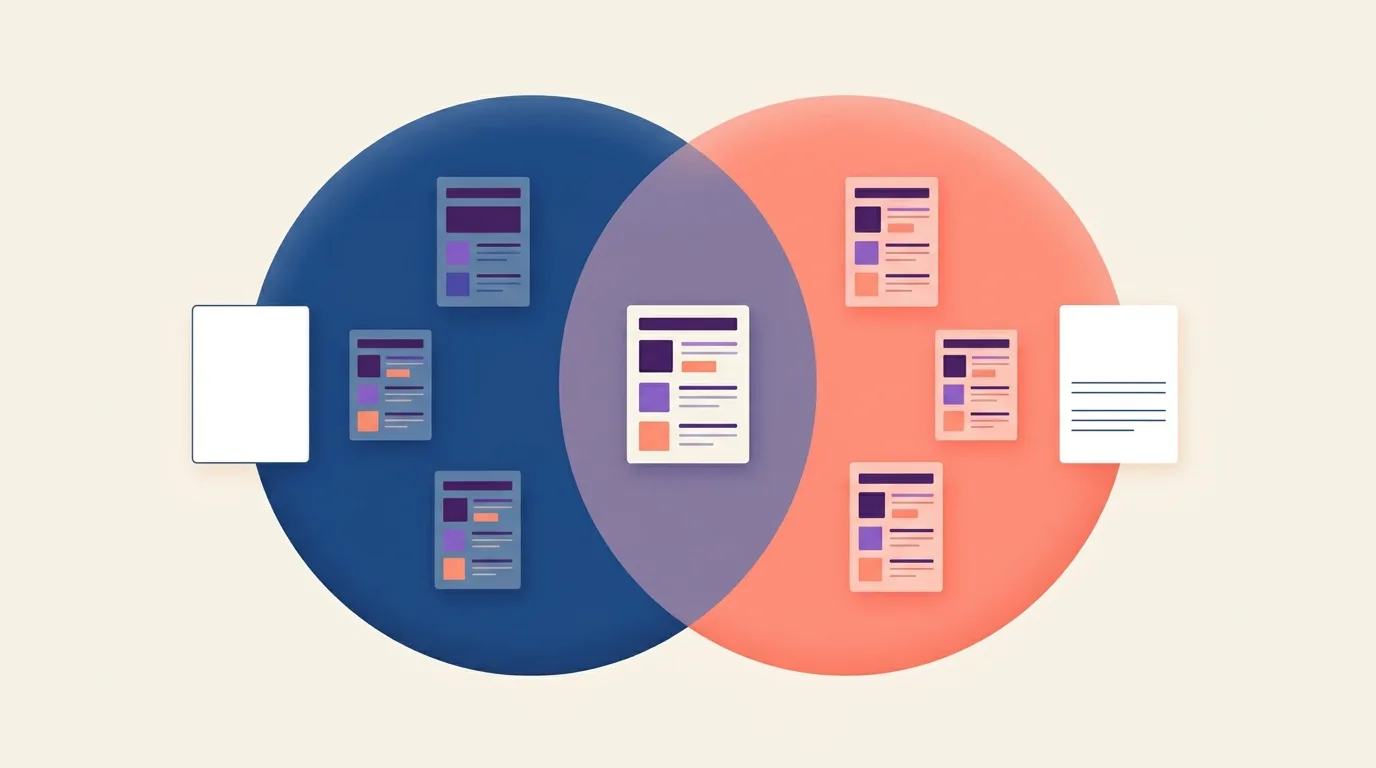
What is keyword and content gap analysis?
Keyword and content gap analysis compares your organic search visibility and topic coverage with competitors and audience needs. It identifies queries where your rankings are missing or weaker, plus questions your content does not answer well. These findings become opportunities to validate, not instructions to copy competing pages.
- A keyword gap is ranking-based. Compare competitor rankings with your own visibility, including missing queries and keyword overlap: queries where both sites appear.
- A content gap is audience-based. It may be a topic absent from your site, an incomplete explanation, or an unmet need that competing pages also overlook.
Neither gap automatically proves the other. A weak ranking does not establish that content is missing, and an unanswered question may not appear in a ranking comparison. A page can also rank without explicitly targeting an exact phrase because Google can relate queries to its meaning, as explained in the Google SEO Starter Guide.
Unlike broader keyword research, which discovers search opportunities, gap analysis compares existing coverage and visibility.
The deliverable is a validated, prioritized backlog of useful improvements, not an unfiltered keyword export.
Why do gaps matter beyond finding more keywords?
Validated gaps show where content effort can serve audience needs, not just add keywords. They help you find overlooked opportunities, improve underperforming pages, and separate useful updates from genuinely missing resources. This supports better-informed allocation of content effort around audience tasks, business relevance, and your ability to provide a useful answer.
- Improve an existing page. If a relevant page already addresses the task but leaves an important question unanswered, strengthen its explanation rather than create another page.
- Identify a missing resource. If no existing page can adequately support a distinct audience task, consider a dedicated resource with a clear purpose.
- Reject irrelevant opportunities. A competitor ranking is not a reason to pursue a topic that lacks business relevance or falls outside your expertise.
Search volume estimates screen potential demand; they do not reveal competitor conversions or predict your traffic.
Google recommends serving an existing or intended audience, and flags traffic-led expansion into topics without expertise as a warning sign (Google Search Central).
Content Strategy and Planning turns validated opportunities into a broader editorial plan with priorities and resources.
Prepare a comparable set of sites and pages
This section sets the audience, scope, and comparison settings for a useful organic gap analysis.
- Define the scope. Specify audience needs, the topic or product area, market, language, and site scope before comparing rankings. Compare equivalent sections or pages when whole-domain exports would mix unrelated offerings or markets.
- Choose relevant search competitors. These are sites appearing for your target queries, not just businesses selling similar products. Use Google results and competitor-ranking platforms to find candidates; follow SEO Competitor Analysis for selection.
- Match the settings. Use a consistent country database, device where available, observation period, and ranking threshold. Mismatched settings can make differences in location, timing, or reporting cutoffs look like gaps.
- Gather your inputs. Bring an existing page inventory and your own query data, including Google Search Console data. Use the Content Audit process if you need to build an inventory.
- Keep the comparison organic. Semrush Keyword Gap and Ahrefs Content Gap are examples to consider; see Keyword Research Tools for tool selection. Exclude paid-keyword exports and advertising-strategy analysis from this workflow.
Compare rankings and build a candidate gap list
A ranking comparison builds a candidate gap list by matching competitor queries against your own keyword list.
- Compare and export. Compare your domain or section with the selected competitors. Export query-level rankings and ranking URLs using consistent comparison settings.
- Group the candidates. Use these working categories; tool labels vary:
- Missing visibility: a competitor has an observed ranking, but your site does not.
- Weaker shared visibility: both sites rank, but yours appears lower.
- Overlap worth inspecting: shared queries where the ranking pages deserve comparison. A weaker shared query may need investigation, not a new page.
- Keep the evidence. Record the query, competitor URL, your ranking URL if present, observed positions, market, export date, and search volume or keyword difficulty estimates.
- Clean the list. Remove irrelevant offerings, unsuitable locations, duplicate rows, and competitor-brand navigation queries your site cannot usefully satisfy.
No observed ranking means absence within that dataset, not proof that your site never ranks or lacks relevant content.
Rankings, search volume, and difficulty are useful sorting fields, but volume and difficulty remain estimates, not certain opportunity scores; see Keyword Research Tools for metric and tool interpretation.
How do you validate a real content gap?
Validate a real content gap by checking current search results, representative competing resources, and your nearest existing page. Confirm an unmet audience need, not just a missing ranking. Record the task, expected answer, current coverage, missing help, and distinctive value you could add.
Search intent determines whether pages serve the same task.
- Inspect manually. Review competing guides, product pages, videos, and other resources for depth, relevance, expertise, and helpful multimedia—not length. Google recommends original information, comprehensive coverage, and added value (Google Search Central).
- Classify the shortfall. Distinguish an absent topic from incomplete coverage, weak evidence, an unsuitable format, or outdated information; see content formats for format selection. Missing exact terms alone proves little: Google can match pages to queries without them (Google SEO Starter Guide).
- Check audience questions. Customer feedback can reveal needs keyword exports miss. Treat comments as qualitative clues, not ranking signals.
A “best running shoes” ranking gap is not automatically a new-page brief. An unanswered question about evaluating fit may instead justify improving an existing fitting guide.
Weak rankings despite adequate content may need a separate competitive diagnosis or technical SEO audit.
Prioritize gaps and specify the next action
Gap prioritization ranks validated opportunities and assigns each a next action based on fit, evidence, value, demand, feasibility, and effort.
Set qualitative priorities
Use priority bands, not a universal scoring formula:
- High: Strong audience and business fit, clear evidence, plausible demand, useful expertise, and manageable effort.
- Medium: Relevant, but demand, competitive feasibility, or delivery cost needs checking.
- Low: Limited value or weak fit, even if keyword difficulty looks favorable.
Google advises serving an intended audience rather than entering unfamiliar topics mainly for traffic: Google Search Central.
Choose the next action
Update an existing resource, propose a genuinely distinct resource, defer for evidence, or reject an irrelevant opportunity.
Update the fitting guide only if it serves the same task and can supply the missing practical guidance.
Specify original insights, not copied coverage; Google recommends substantial added value: Google Search Central.
Record the decision
A backlog entry captures: audience need; evidence; existing URL; proposed action; unique contribution; priority rationale; owner; baseline metric.
Keyword mapping determines final query-to-URL ownership.
Content optimization covers detailed page improvements.
Content workflow handles the production handoff.
Common mistakes that turn gaps into busywork
This section covers mistakes that turn keyword and content gap analysis into unnecessary work.
- Chasing every competitor keyword. Keep audience needs central. A missing phrase does not always need a new page: Google can relate pages to queries without exact wording, as its SEO Starter Guide explains.
- Copying surface features. Matching headings, word counts, or keyword frequency does not establish additional value. Longer is not inherently better; Google recommends original information and substantial value beyond existing results in its helpful content guidance.
- Treating scores as shortcuts. Long-tail wording or a low keyword difficulty score alone cannot establish a quick ranking opportunity.
- Confusing signals with outcomes. CPC, social shares, and estimated competitor traffic do not establish organic success or prove an opportunity suits your site.
- Assuming AI visibility. Conventional keyword-gap exports do not establish visibility in AI-generated answers; use the separate approach in Measuring Visibility in AI Answers.
For natural use of relevant search language in prominent page locations, as recommended by Google Search Essentials, see On-Page Keyword Optimization.
How can you check whether a gap was closed?
Check whether a gap was closed by reviewing content completion separately from search outcomes. Confirm that the documented audience need is now adequately answered, then compare relevant visibility and measured results with your baseline. A completed update does not establish search success, and observed changes may have other causes.
Keep a repeatable review record
A review record preserves the evidence needed to assess the work.
- Save the original comparison settings, affected URLs, query groups, baseline observations, and implementation date.
- Re-run the comparison with consistent settings. Review keyword performance and underperforming pages; do not assume a fixed response time.
- Check seasonality, competitor changes, and other site changes before attributing gains or losses to the update.
Google Search Console provides owned-site query and page reporting for reviewing impressions and clicks.
Measuring Content Performance covers outcome evaluation using your own site’s measured results, including business outcomes.
Competitor traffic estimates are not equivalent to first-party analytics; keep them separate.
Revisit the candidate list
The candidate list is a working record, not a permanent plan. Reconsider rejected or deferred gaps when audience needs or evidence change.
Frequently asked questions
Can you do keyword and content gap analysis without a paid tool?
A manual gap analysis compares audience needs and competing pages with your own content. You can do it without a paid tool. List relevant searches, inspect the results, and record missing topics or weak coverage in a spreadsheet. Group related searches by the need they express. Focus on useful additions, not copying every keyword a competitor uses.
Can a new website with no rankings still run a useful gap analysis?
A new-site gap analysis identifies unmet audience needs rather than differences in existing rankings. Start with your intended customers, their questions, and the pages that address those questions in search results. Compare those needs with your planned content and expertise. Google recommends creating content for an existing or intended audience, not entering unfamiliar topics mainly for search traffic: Google Search Central.
Why do different keyword-gap tools return different opportunities?
Keyword-gap results are comparisons within a tool’s dataset, not a complete list of audience needs. Differences can reflect keyword coverage, collection timing, location settings, and how each tool defines a missing opportunity. Check those inputs before comparing reports. Treat each suggestion as a lead to assess against search intent, your existing pages, and business relevance—not as an automatic content assignment.
Should you compare your site with marketplaces and large publishers?
Marketplaces and large publishers are useful comparison sites when their pages serve the same audience need as yours. Compare relevant pages or topic areas, not their entire keyword footprint. Exclude searches tied to products, formats, or audiences you do not serve. Use the comparison to identify where you can add substantial value, as recommended by Google Search Central.