

Updated November 3, 2026 · By RAMRAD · Reviewed by Robin Rad
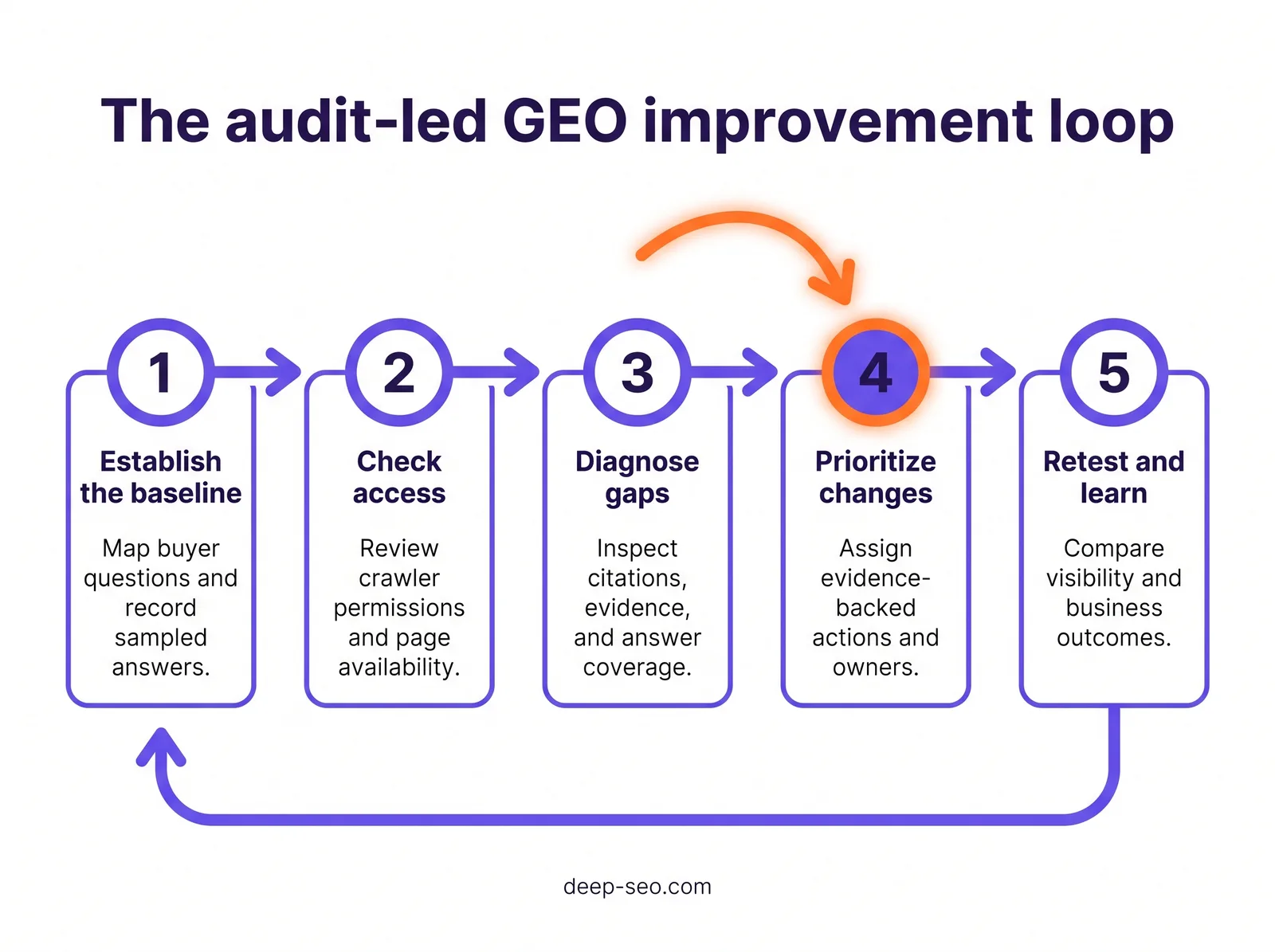
Generative engine optimization best practices start with an audit. Can AI search systems reach your content, and does your brand appear in answers that matter to buyers? Map the questions your customers ask, then check for crawl blocks. Review your answers for clarity and check the evidence behind them. Track citations alongside useful traffic and conversions: brand mentions alone aren’t enough.
Your AI search baseline gives you a starting point for choosing what to fix. Look for pages that need clearer answers or stronger sources. Check why citations may be missing rather than assuming every gap has the same cause.
Keep access problems separate from content gaps so your work plan addresses the right issue. Build that plan with the AI GEO / AEO Audit. For related advice, visit our GEO and AEO resource hub.
What is generative engine optimization, and why start with an audit?
Generative engine optimization (GEO) is work aimed at helping your brand appear in AI-generated answers and be described correctly. It overlaps with search engine optimization (SEO) and answer engine optimization (AEO). An audit shows where your current presence falls short on questions that matter to your customers.

The work overlaps, but each discipline has a different focus. SEO helps people and search systems find useful pages. AEO focuses on clear answers to questions, while GEO looks at how AI answers describe your brand and use your content as a source.
Separate visibility from business outcomes
Before you track performance, separate what each measure tells you:
- Brand mentions name your business.
- AI citations identify your content as a source.
- A referral visit means someone follows a link.
- A conversion means someone takes a valuable action, such as submitting an enquiry.
Citation counts alone can’t tell you whether your brand appears in relevant buying decisions. They don’t tell you whether the answers describe it correctly, either.
Read click evidence in context
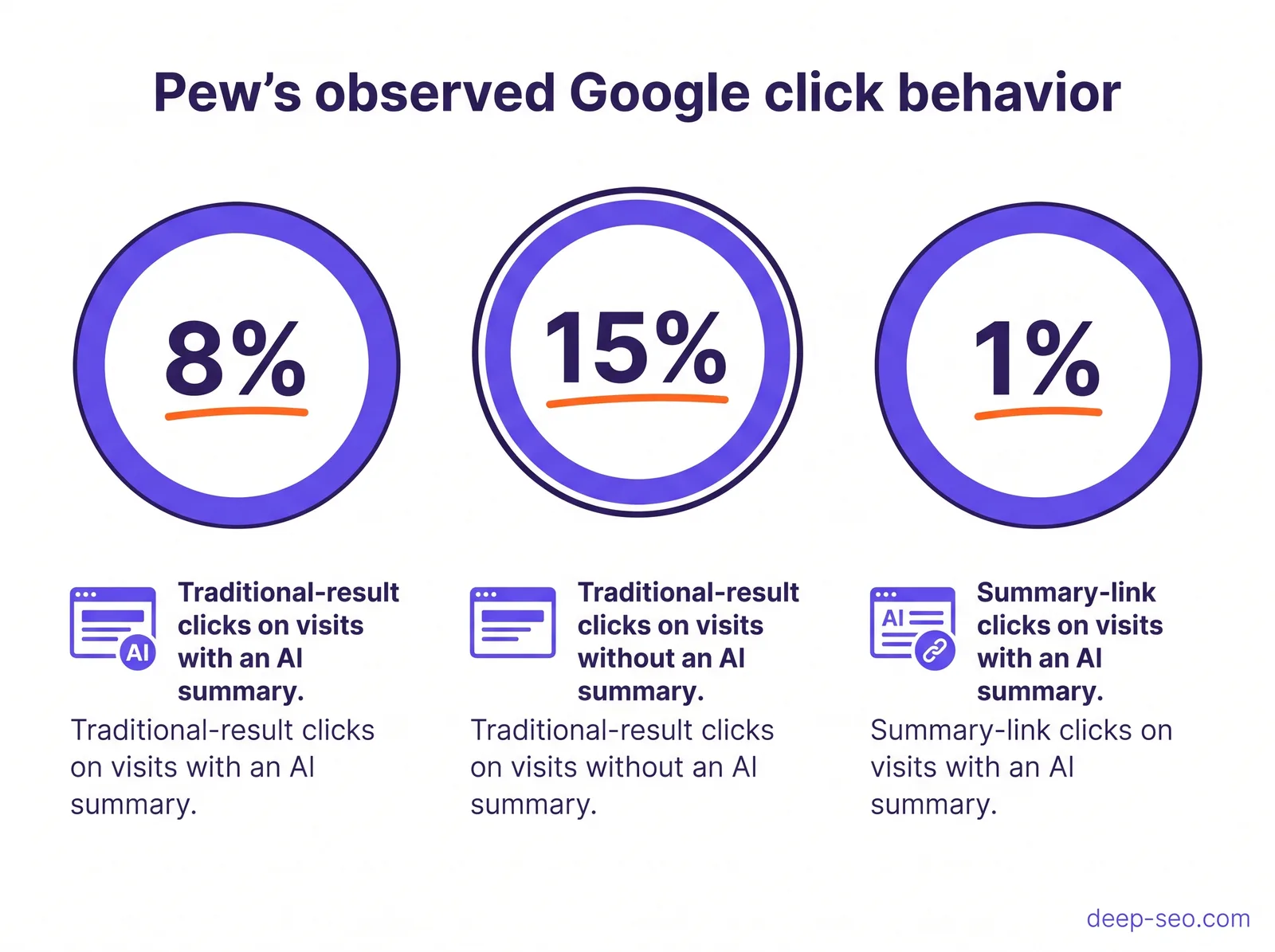
Pew Research Center studied 68,879 Google searches from 900 U.S. adults. Users clicked traditional results on 8% of visits with AI summaries versus 15% without them (Pew Research Center).
Users clicked links inside summaries on 1% of visits to pages with a summary (Pew Research Center). Those findings aren’t a forecast for every site or answer engine.
Ahrefs estimated that AI Overview presence was linked with a 58% lower desktop click-through rate for the top-ranking page in December 2025. Its comparison used a modeled baseline without AI Overviews (Ahrefs). Unlike Pew’s study of browsing activity, this was a modeled estimate. Don’t combine the findings into a single traffic-loss claim.
In an announcement updated August 31, 2026, Google reported more than 2.5 billion monthly active AI Overviews users and more than 1 billion monthly AI Mode users (Google). These are separate usage figures tied to that date, not evidence of results for your site.
How do you build an AI search visibility baseline?
Test buyer questions across the engines your audience uses. Link each prompt to a business goal, then record brand mentions and citations. Check whether the answer is correct, too. Repeat the checks with the same template so you can see how answers vary.
Build a prompt inventory from buyer research
Pull buyer questions from:
- Sales calls
- Customer interviews
- Support tickets
- Search query data, where available
Include basic questions and comparisons, as well as questions about use cases or reasons not to buy. Keep buyers’ wording rather than rewriting every question around a keyword. You can start with customer questions even if you don’t have search data.
Include detailed questions: AI summaries appeared on 53% of Google searches with at least 10 words, versus 8% with one or two words, according to Pew Research Center.
That’s a reason to test detailed buyer questions, not to assume longer prompts will earn visibility.
For each prompt, record who is asking and what they need. Assign a target page and business goal. A supplier comparison question, for example, might point to a page that helps buyers weigh service options.
Record answers consistently
Use the same template for every check:
- Test context: Record the engine and date, along with the market, language, and exact prompt.
- Brand mentions: Note whether your brand appears and how the answer describes it.
- AI citations: Save the linked sources and the pages they point to.
- Accuracy: Record correct claims and flag errors or claims without support.
Label Google AI Overviews and Google AI Mode separately. Save the answer text so colleagues can check the evidence.
Repeat checks across dates using the same prompts and settings. These are practical samples, not a complete view of what all users see.
Separate observations from suspected causes
A missing citation records an absence. It doesn’t prove that a page is blocked or that its content is weak.
Create an audit worksheet with fields for:
- Evidence
- Suspected issue
- Proposed action
- Owner
- How to check the fix
Treat suspected causes as ideas to test until further checks support them. Use the baseline to choose what to investigate, or explore the AI GEO / AEO Audit for help reviewing your findings.
How can you check whether AI search crawlers can access your content?
Check whether relevant AI crawlers can reach your public pages and read the content you want available for answers. Review access rules and page-level limits. Key facts shouldn’t depend on a visitor clicking a button or logging in. Check each crawler’s purpose before changing its access, and agree on changes with the site owner.

Use a permission-review checklist
- robots.txt: Check rules for each relevant crawler and page path. Flag accidental blocks, but don’t assume every crawler needs access.
- HTTP responses: Check where redirects lead and investigate errors. Look for security checks that stop public pages from returning usable content.
- Indexing directives: Review page-level robots instructions and response headers. Flag rules that conflict with the page’s purpose.
- Canonical targets: Check that each canonical tag points to the preferred page and that crawlers can reach it.
- Authentication: Look for login walls or consent gates that block public facts. Check whether security controls block crawlers, too.
- Delivered content: Inspect the returned page and its rendered version. Check whether key facts depend on scripts or user actions.
Crawl access isn’t proof that a page can be indexed. A crawler may reach a page without indexing it, and an indexed page may receive no AI citations. Check answer inclusion separately.
Separate search access from training permissions
You can allow OAI-SearchBot for search visibility without allowing GPTBot to use content for model training, according to OpenAI. Involve the site owner in both decisions rather than advising blanket access.
OpenAI says its search systems can take approximately 24 hours to adjust after robots.txt updates (OpenAI). Allow for that delay, but don’t treat it as an indexing deadline or a promise of visibility.
Record a testable technical finding
If a public service page redirects to login, record the affected URL and where it leads. State what should happen instead: public access to the service content. To retest, request that URL without logging in, follow the redirects, and inspect the page. Save the result alongside your proposed fix.
Do you need special schema or llms.txt for AI search?
Not for Google’s AI search features. Google says they don’t require structured data or special Schema.org markup (Google). Google Search ignores llms.txt, so maintaining it neither helps nor harms Search visibility or rankings (Google). That advice doesn’t cover every AI search provider.

Separate access permissions from markup
Crawler permissions control access. Structured data labels page content. An llms.txt file isn’t a substitute for either.
| Control or file | Provider guidance | What to check | Source |
|---|---|---|---|
| OAI-SearchBot permission | Search access can be managed separately from GPTBot training access. | Check the intended search-access policy. | OpenAI |
| GPTBot permission | Training access can be managed separately from OAI-SearchBot. | Make a separate decision about training access. | OpenAI |
| Structured data | Google doesn’t require structured data or special Schema.org markup for generative AI search. | Don’t treat special AI schema as a requirement. | |
| llms.txt | Google Search ignores the file; it neither helps nor harms Search visibility or rankings. | Don’t prioritize it as a Google visibility fix or apply this advice to all providers. |
Prioritize demonstrated issues
Keep relevant structured data accurate and aligned with what visitors see on the page. Maintain it for the search features it supports, not to meet a supposed rule for AI citations.
Refer to the access checks above for crawler permissions.
Before making a change, ask which provider supports it and what documented problem it solves. Fix known access barriers and content errors before spending time on unsupported advice about special AI files.
Curious how your own site does? Run the free website check and RamradOS, our AI SEO assistant, picks it up from there. Start the free check →
How should you structure content for useful, supportable answers?
Start with a direct answer under a clear question heading. Put limits or conditions close to that answer, and cite sources for factual claims. Each passage should make sense on its own. Include dates when readers need to judge whether the advice still applies.
Organise each passage around a reader’s question
A heading such as “What does this service include?” tells readers more than a vague label like “Our approach”. Define unfamiliar terms briefly. Don’t leave important conditions in a distant footnote.
Use comparison tables when readers need to weigh options against shared criteria. If the decision needs more context, use prose. Readers shouldn’t have to hunt through nearby sections to understand an answer.
These are ways to make content easier to use, not a formula for AI citations. No format alone secures a place in an AI answer.
Separate evidence from advice
Place sources next to the factual claims they support. When you cite research, explain what it measured and where its limits lie. Make it clear when you’re giving advice rather than reporting a finding.
An example can then show how to apply the advice. Give readers a useful next step, such as checking service scope or asking for supporting records.
Before: “A powerful audit gives your business unmatched AI visibility.”
After: “An AI content audit should check whether your pages answer buyer questions clearly and support factual claims with evidence. Use the findings to choose which pages need clearer wording or better sources.”
This is a wording change only. It replaces an unsupported outcome claim with a clear description of the work, without claiming measured results.
Keep descriptions and updates consistent
Check these descriptions across relevant pages:
- Brand
- Product
- Author
- Service
Resolve conflicting names or credentials, and check for mismatches in scope or availability. Use only credentials you can verify.
For time-sensitive advice, include relevant dates. Explain what changed and why it matters. Don’t refresh a date without checking the content behind it.
Turn citation gaps into evidence and authority priorities
A citation gap occurs when a relevant sampled answer cites other sources but leaves out your target site. A missing brand name is a mention gap. An answer that gets your business details wrong is an accuracy problem. Track these separately because they may need different fixes.

Review what the cited sources provide
Start with your baseline samples and check the cited pages:
- Relevance: Does the page answer the buyer’s actual question?
- Evidence quality: Can readers check its claims and trace its sources?
- Question coverage: Does it explain key conditions and limits? Does it address related decisions?
- Freshness: Is the information current enough for the topic?
- Source type: Is it an official document, research report, directory, or industry discussion?
Use these checks to guide your research, not as proven ranking factors. A citation alone doesn’t tell you why a source appeared.
Classify the gap before choosing work
Give each gap a label:
- Missing coverage
- Weak supporting evidence
- Unclear brand or business details
- Technical access issues
- An unresolved cause
Refer back to your access checks before assigning technical work. If the cause is unclear, leave it unresolved rather than forcing an explanation.
Where evidence is weak, consider:
- Original research
- Documented examples
- Clear research methods
- Expert contributions
Publish only what your business can support. Explain how you gathered the evidence and where its limits lie. Describe contributors’ relevant expertise without inflating their credentials.
Check that your business name and service details match across your site and accurate third-party profiles. Join relevant industry discussions where you can add useful knowledge, but reject fabricated endorsements and spam. Don’t accept paid promises of citations.
Turn findings into a testable backlog
Rank work by its value to buyers and the strength of the evidence, then weigh the effort needed. For each item, record:
- The affected question
- The proposed change
- The owner
- How you’ll check the fix
After making changes, repeat the relevant prompts. Compare citations and mentions, and check the facts. Log answer variation because a changed response doesn’t prove your edit caused it.
To organize the work, review the AI GEO / AEO Audit scope and identify which gaps need deeper investigation.
Which generative engine optimization tools and metrics should you use?
Choose generative engine optimization tools by the job, not vendor rankings. You’ll need ways to inspect page access and save sampled answers. Platform reports and site analytics serve different purposes, so keep their measures separate. Record what each metric covers and what its rate is based on.
Match tools to the job
- Technical inspection: Use crawl checks and server logs to investigate the access issues covered earlier.
- Sampled answer monitoring: Capture answers and sources for your baseline prompts.
- First-party visibility reporting: Use platform reports within their stated scope.
- Analytics: Track referrals you can identify and the conversions credited to them. Document how you assign that credit.
On June 16, 2026, Bing introduced globally available preview capabilities in its AI Performance report (Bing):
- Intents
- Topics
- Citation Share
- Compare
That dated announcement describes preview features, not a fixed feature set. They extend the report beyond raw citation counts, but they don’t measure every answer engine.
Keep a measurement sheet
Record counts alongside rates. Each row needs the engine and prompt set, plus the date range and any exclusions.
| Metric | How to calculate it and define its scope |
|---|---|
| Brand mentions | Answers naming your brand divided by sampled answers from the tested engines. |
| Linked citations | Answers linking to your site divided by sampled answers. Label this sampled citation frequency. |
| Answer accuracy | Answers passing your factual checks divided by sampled answers you could assess. Record unknowns separately. |
| Identifiable referral visits | Recognised AI referral visits divided by measured site visits in the same period. |
| Attributed conversions | Conversions credited to those referrals divided by eligible tracked referral visits. State the time window used to assign credit. |
Sampled citation frequency isn’t the same as Bing’s Citation Share. Check how Bing defines the measure and what it covers before comparing them.
Interpret changes with care
After edits, compare the same prompts on the same engines under matching conditions. Save dated answers with their source links, and keep a record of page changes. Don’t assume the latest edit caused every shift.
Answer checks measure presence in your sample. Referral analytics measures visits and actions you can identify. Neither gives you the full picture: samples have limits, referral sources can be missing, and conversion credit depends on your tracking rules.
Build an audit-led roadmap with the AI GEO / AEO Audit
Use your findings to build a work plan, not a separate wish list for AI search. A task needs a clear reason to exist. Start with known problems on pages that matter to buyers rather than tactics based on guesses.

Move from findings to implementation
Say your service page answers “Does installation cost extra?” with “Contact us”, but an approved service document explains when installation is included. Assign the content owner to add those terms beside the service description, using the document as the source. Ask the service owner to check the wording before it goes live.
The first check is whether the page now gives a correct, useful answer. You can then repeat the buyer prompt to watch for changes in AI answers. Those are separate checks: fixing the page doesn’t mean an engine will cite it.
If the same page is blocked from intended crawlers, resolve that access issue first. A clearer answer won’t address a crawl block. Content work can follow once the technical owner has checked access.
Use this table to keep the handoff clear. It’s a planning aid, not a scoring model.
| Field | What to record |
|---|---|
| Finding | The specific issue or opportunity. |
| Evidence | The saved answer, crawl result, or page extract that supports it. |
| Affected page or prompt | The URL or buyer question that needs attention. |
| Recommended change | The smallest useful action that addresses the evidence. |
| Responsible owner | The person who will deliver and coordinate the work. |
| Success criterion | A check you can observe, such as restored access or corrected wording. |
Keep completed fixes separate from changes in citations or mentions. Use the same prompt set and recording method when you compare answers with the baseline.
Choose a review that fits your needs
A focused internal review may be enough if you know which pages are affected and who owns the work. Assign the task, verify the fix, and continue measuring.
A broader audit may be useful when access issues overlap with weak evidence or conflicting business details. It can also give teams a shared basis for choosing work when priorities are disputed or no baseline exists.
If you want help assessing AI search visibility, consider Deep SEO’s AI GEO / AEO Audit. Check the scope and deliverables on the product page before deciding whether it’s the right fit.
For related advice as you refine your generative engine optimization best practices, explore the GEO/AEO hub.
Read more
Frequently asked questions
How should a small team choose its first pages for a GEO pilot?
Start with pages that answer important customer questions and support clear business goals. Choose a manageable set that your team can update without major development work. Use existing search or conversion data where available; it isn’t a prerequisite. If you don’t have it, establish a baseline with sampled answers and citations, then set up referral and conversion tracking where practical. Avoid changing everything at once, because that makes each edit harder to assess.
Who should own GEO work, and how should teams divide responsibilities?
Assign a lead who can coordinate work across teams, often the SEO lead. Content owns clear, accurate pages and keeps them updated. Analytics defines measures and tracks changes, while engineering handles crawl access and technical fixes. Give each task a named owner and a clear check for completion. Keep a shared backlog so GEO work fits your existing publishing and development process.
Should multilingual sites run separate audits for each language and market?
Yes. Audit each language and market separately, but share a common checklist. Markets can differ in:
- Customer questions
- Product availability
- Terminology
- Cited sources
Test local buyer questions rather than relying only on translated queries. Ask native speakers to check meaning and accuracy. Review language targeting and regional business details, then check local landing pages alongside technical issues that affect the whole site.
What should you do when an AI-generated answer misrepresents your business?
Save the details your team needs to investigate:
- The prompt
- The answer
- Cited sources
- The date
- The market
Check whether the error comes from your site, another source, or a claim with no clear source. Correct unclear wording on pages you control and request corrections elsewhere. Use the platform’s feedback tools where available. Repeat the query later, but don’t treat a changed answer as proof that the error is resolved for all users.
What should you prepare before commissioning an AI GEO / AEO Audit?
Prepare your business goals and priority audiences. Include the markets and key products or services that matter. Share:
- Relevant customer questions
- Priority URLs
- Past site changes
- Known technical issues
Arrange read-only access to analytics and webmaster tools where available. Provide any examples of missing citations or incorrect AI answers. Before work starts, agree on the scope and baseline measures, as well as the deliverables and who will make the changes.
Key takeaways
- Start with business value. Focus on gaps that affect buyer decisions rather than chasing every missing mention.
- Let evidence guide each fix. Separate access problems from weak support for claims or conflicting brand details. Give each issue a clear owner.
- Read measures in context. Sampled answers aren’t a complete market picture. Check accuracy alongside visibility and useful customer actions.
- Make the audit repeatable. Record what changed and why so you can revisit the same checks. Use the findings to choose work, not just add tasks.
Use these generative engine optimization best practices to shape a focused work plan, with support from the AI GEO / AEO Audit if you need it.
See what this means for your website
Start with the free check. RamradOS explains the results and, if it fits, our AI GEO / AEO Audit goes deeper.
Check your website free — in one minute
Our AI platform reviews your site and shows what to fix first. Our SEO team can implement it for you.