
Quick answer: Local SEO is the practice of improving a business’s visibility when people search for products or services in a particular area. It connects accurate business information, a useful website, and evidence of reputation. Google’s local results mainly depend on relevance, distance, and prominence, so optimization cannot guarantee rankings everywhere.
Key facts
- Google shows local business results in both Search and Maps. Tips to improve your local ranking on Google
- Local results mainly depend on relevance, distance, and prominence; businesses cannot pay Google for better local rankings. Tips to improve your local ranking on Google
- Google recommends complete, accurate Business Profile details, including categories and opening hours. Tips to improve your local ranking on Google
- Customer reviews and links from other websites can contribute to local prominence. Tips to improve your local ranking on Google
TL;DR: Build an accurate, trustworthy local presence around the customers and places you genuinely serve, then measure qualified business outcomes rather than rankings alone.
- Local SEO
- Improving a business’s online presence to help people discover it through geographically relevant searches.
- Local intent
- A searcher’s need for a product, service, or business in a particular area, whether or not the query names that area.
- Local pack
- A group of local business listings displayed within Google Search, typically alongside a map.
- Prominence
- How well known a business is, reflected partly through signals such as customer reviews and links from other websites.
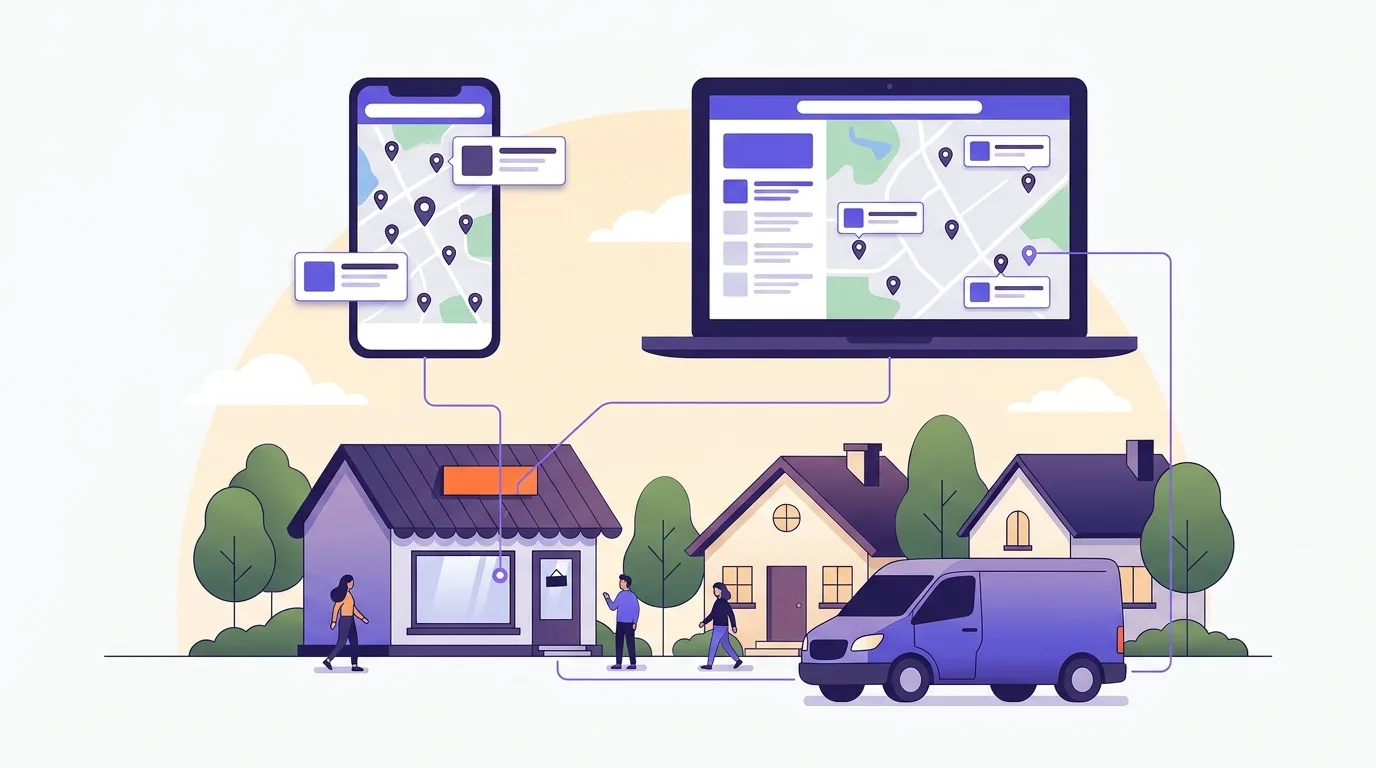
What is local SEO, and where does it apply?
Local SEO is the work you do to help people find your business when they search for something nearby. The goal is to reach people who need your services in an area you serve, rather than anywhere online.
Local SEO guide: Search and Maps
Your business can appear through its listing or its website. Google shows local business results in Search and Maps. A Business Profile can help improve your local ranking, according to Google.
- Local pack: a group of business listings within search results.
- Local organic results: website pages that answer searches with a local need.
These are different ways to be found, not identical ranking systems.
Who local SEO is for
Local SEO applies to shops and other places customers visit. It also applies to businesses that travel to customers, including those run from home. If you have several locations, each needs details that match how it operates.
Google Business Profile covers who can have a profile and how to manage it.
Mobile and “Near Me” Local Search explains how people search nearby and take action on their phones.
Why does local SEO matter for customer discovery?
People can need a local business even when they don’t type a city name. Someone searching for a bike repair shop may want to visit today. Your opening hours and repair details help them decide whether to call or keep looking.
From discovery to a useful next step
- Discover: Find a business that offers the service in the right area.
- Check: Confirm that it can meet the need. For the bike shop, that might mean checking whether it accepts walk-in repairs.
- Act: Call or book once the details support that choice.
If your listing gets views but few inquiries, check whether people can tell what you offer and how to reach you.
Local keywords covers how to research the terms people use for services in the places you serve.
How do local rankings work, and what should you prioritize?
Local rankings mainly depend on relevance, distance and prominence, according to Google’s local ranking guidance. Start with details you can improve: accurate business categories and a customer-facing address where applicable, plus regular and special opening hours. You can improve how clearly your profile describes your business, but you can’t control the searcher’s location.
| Factor | Plain meaning |
|---|---|
| Relevance | How well your business matches what someone needs. |
| Distance | How far your business is from the search location. |
| Prominence | How well known your business is. |
Google says you can’t request or pay for a better local ranking. These factors describe Google’s local results, not all website rankings.
A practical order of work
- Confirm how the business operates. Be clear about what you offer and where you work. Do customers visit you, or do you travel to them?
- Correct the details customers see. Check your address and categories, then your normal and holiday hours. Google recommends keeping these complete and accurate. NAP consistency covers your name, address and phone details across sources. Don’t treat harmless formatting differences as urgent errors. Local citations covers useful listings on other sites.
- Match your website to the business. Make sure it describes services you offer in places you serve. On-page SEO for local pages covers how to make those pages useful.
- Build your reputation. Give customers evidence of real work and genuine customer experiences.
If you have a website, LocalBusiness structured data can communicate location details such as opening hours and departments. Follow Google’s dedicated LocalBusiness guidance to choose the most specific applicable subtype and check required properties. Treat it as a way to describe your business, not a ranking lever; Google may not display structured-data features even when your markup is correct.
Build evidence that the business is relevant and trusted
Say you run a plumbing business. Before booking, a customer may want to know whether you handle their type of leak and travel to their street. Clear service details answer those questions. Reviews about similar work can help them judge whether to contact you.
Evidence of reputation
Google names links from other websites and customer reviews as signs of prominence. It says more reviews and positive ratings can help local ranking, but gives no fixed weights for them in its local ranking guidance.
Local Reviews and Reputation covers how to ask for reviews and respond to feedback.
Local Link Building explains how real local relationships and useful contributions can earn links.
Evidence of local usefulness
If you serve nearby towns but charge for travel outside your main area, explain that before someone books. A town name added to generic copy doesn’t answer that question. Local Content covers how to answer needs that depend on where your customer lives.
Avoid shortcuts and mismatches with the real business
Don’t publish an address where customers can’t find you or claim services you don’t offer. Check that your profile describes the business people will actually deal with.
Keep claims grounded in the real business
- Business name: Use your real-world name. Adding needless words can lead to suspension, according to Google’s business guidelines. Google Business Profile covers the rules for profile details.
- Categories: Choose the fewest needed to describe your core business, as Google recommends.
- Customer reviews: Don’t offer rewards for posting or changing reviews, or for removing negative reviews. Google prohibits those incentives. Use Local Reviews and Reputation for review request methods that follow the rules.
- Multiple locations: Create pages for real business locations, not invented offices. Multi-Location SEO covers how to manage each location’s online presence.
Reject promises of placement everywhere
Reject promises of top positions across your whole area. As the ranking factors above show, you don’t control every part of local placement. A provider should explain what they’ll change, not sell you a position they can’t control.
How should you check progress and choose the next improvement?
Track useful inquiries or sales alongside search visibility. More clicks may be worth investigating, but they don’t tell you whether the business gained customers.
Separate visibility, interactions, and outcomes
| Measure | What it tells you |
|---|---|
| Visibility | Whether you appear for relevant searches in the places you serve. |
| Interactions | Whether people click your website or call button. A click isn’t proof of a sale. |
| Outcomes | Whether inquiries turn into bookings or sales. |
A ranking checked from a single place won’t represent your whole service area. Distance affects local results, as Google explains, so compare checks from the same places over time.
Repeat a focused improvement cycle
- Record your starting position. Use the same searches and locations for future checks.
- Find the most important gap. Wrong hours may need attention before a page rewrite.
- Make a focused change and record when you made it.
- Review search visibility and customer outcomes before choosing the next step.
Local SEO Reporting explains how to bring search data and lead data into a useful report.
Use Local SEO Audit to check your local presence and decide which problems to fix first.
Frequently asked questions
How long does local SEO take to produce results?
There’s no set timeline. The work you need depends on your starting point, and profile updates alone don’t decide where you rank. Google’s local ranking guidance describes the factors covered above. Review changes over time rather than treating a promised date as evidence.
Can a business do local SEO without a website?
If you already manage a Business Profile, you can improve its details independently of website work. Google’s local ranking guidance recommends complete and accurate profile information, but it doesn’t establish whether a website is required for profile eligibility. Check the eligibility guidance before setting up a profile. A website gives you more space to explain your services and answer questions before someone calls.
Can a home-based business use local SEO without displaying its home address?
Yes, if it’s eligible for a Business Profile and serves customers away from home. Google says businesses that don’t serve customers at their address must remove it from their profile and show their service area instead. See Google’s service-area guidance.
Can I manage local SEO myself, or should I hire help?
You can handle routine profile updates yourself if you have time. Consider help when the website work is beyond your skills or managing several locations takes too much time. Ask a provider what they’ll change and how they’ll measure it. Paying for that work is not the same as buying a better ranking; Google says local ranking isn’t for sale.
Entries in this chapter
- Google Business Profile — Claim, fully complete, and actively maintain your Google Business Profile—correct NAP, the right category, fresh photos and posts, and review responses—to win and keep the local pack.
- NAP Consistency — Standardize your business’s name, address, and phone number in one exact format, make your Google Business Profile the source of truth, then audit and correct every directory, website page, and social profile to match it.
- Local Citations — Get your business listed with accurate, consistently formatted NAP details on a focused set of relevant directories, then audit regularly to fix duplicates and errors.
- Local Keywords — Build a shortlist of service-and-location queries, verify their intent in the target area, and prioritize those that match real services, reachable customers, and suitable destination pages.
- On-Page SEO for Local Pages — Make each local page genuinely useful for its intended customers, then align its titles, headings, links, business details, and markup with what the business actually offers there.
- Local Reviews and Reputation — Build a platform-compliant process for requesting honest reviews, responding constructively, and turning recurring feedback into service improvements.
- Local Link Building — Earn locally relevant links through genuine community contributions, ask for useful editorial links, and measure qualified referrals rather than chasing link counts.
- Local Content — Publish content that answers a real local customer question with verifiable, firsthand details, then maintain it and assess whether it helps people take a useful next step.
- Mobile and ‘Near Me’ Local Search — Match nearby customers’ needs with accurate local information and a tested mobile path from search to the right call, directions, or booking destination.
- Multi-Location SEO — Build a maintained location inventory that connects each real branch to its page, eligible profile, responsible owner, and location-level results.
- Local SEO Reporting — Build one recurring dashboard that combines Google Business Profile insights, local pack rankings, and conversion tracking (calls, direction requests, form fills) so you can prove impact and decide what to fix next.
Local SEO — frequently asked questions