

Updated October 29, 2026 · By RAMRAD · Reviewed by Robin Rad
An SEO content strategy ties what your audience needs and searches for to your business goals. You use it to decide which pages to create, improve, or retire—and which take priority. Someone needs to own the work, and you need a way to measure its value. A full publishing calendar isn’t the goal; useful content is.
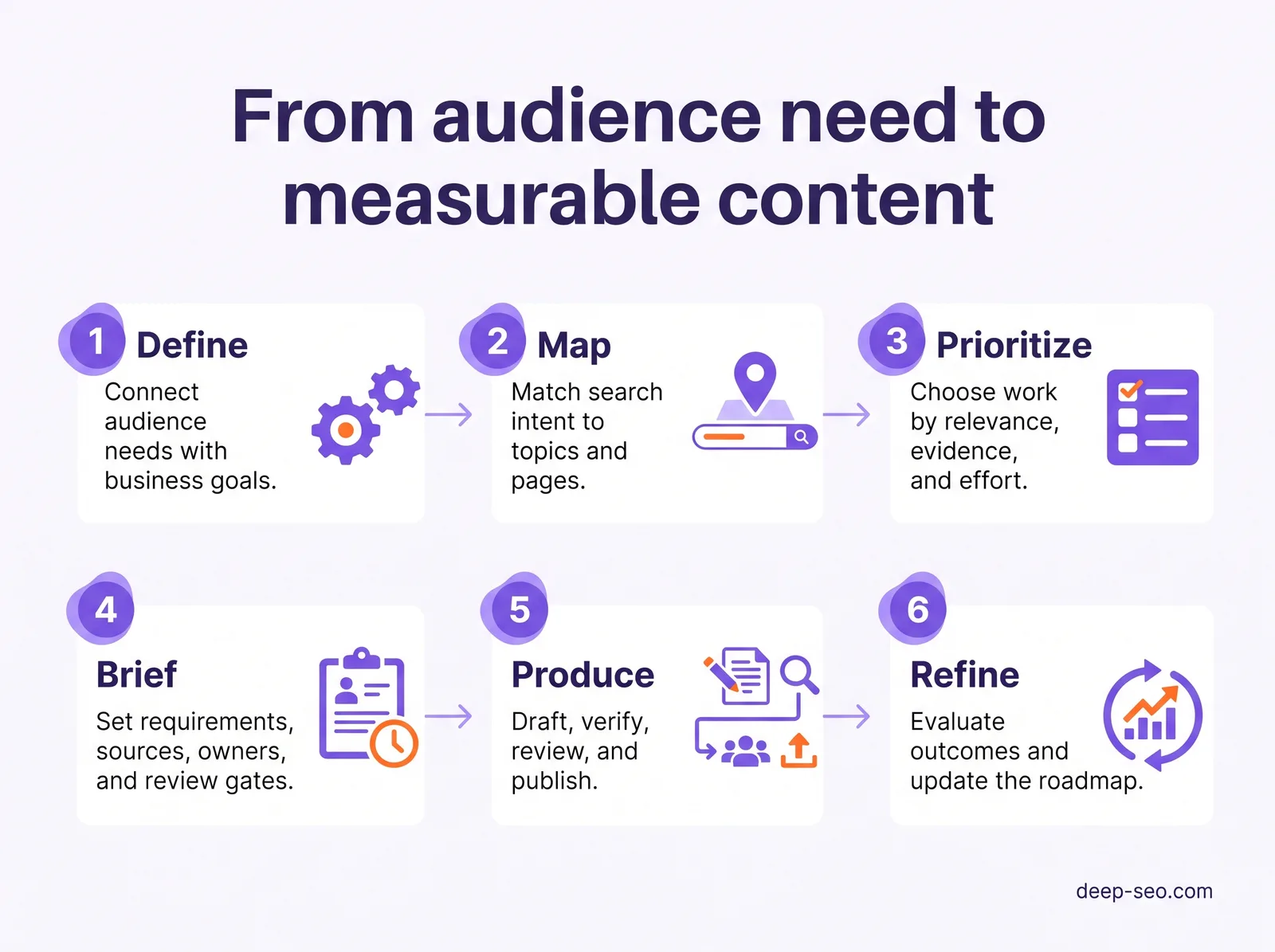
Turn audience questions into a page map, then build a clear production plan around it. Account for:
- Topic clusters
- Content briefs
- Review steps
- Internal links
- Measurement
ChatGPT can help with the work, but people still need to make the decisions.
For broader platform context, explore Deep SEO’s AI SEO platform.
What is included in a content strategy?
A content strategy defines your audience and connects their needs to business goals. It sets rules for choosing topics and deciding which ideas deserve resources. Those rules cover how pages get produced and shared, along with how you’ll assess their value once they’re in use.

Treat your SEO content strategy as a decision framework, not just a keyword list. It should help you reject ideas that don’t fit or reshape them into something worth producing. Search data can reveal demand, but your team still has to decide how best to meet it.
Define the choices behind the work
- Audience and goals: Name your readers and their questions. Be clear about the business outcomes the content should support.
- Intent and page structure: Give each page a clear job. Group related pages and link them where it helps readers.
- Priorities and owners: Set rules for choosing work. Decide who writes and reviews it, then who handles approval and upkeep.
- Sharing and measurement: Choose where to share content and how to assess its value.
Separate strategy from its working documents
Your editorial roadmap lists work in priority order, while the calendar sets delivery dates. A content brief defines the page’s reader and purpose; it should specify sources and the reader’s next action too. These documents put your strategy into practice. They don’t replace it.
Say you run a software firm. Your guide explains a work problem, while a comparison page helps readers weigh their options. The product page has a different job: explaining whether the software fits their needs. Link each page to useful next steps rather than treating them as interchangeable.
Refine the plan as you learn
In CMI and MarketingProfs’ 2026 survey of 1,015 B2B marketers, some respondents reported that their content strategy had become more effective. Of that group, 74% credited strategy refinement, while 51% credited new technology. See the CMI and MarketingProfs research.
Those are reported contributors, not proof of cause and effect. Revisit your choices when audience needs or business goals change. A shift in page performance warrants a review too, but don’t assume a new tool is the best answer.
Which business goals and audience needs should guide the strategy?
Start with a business goal, such as more qualified enquiries or better customer retention, then decide whose needs your content should serve. Define the reader’s problem and the information they need before choosing keywords. Only approve a topic when evidence connects that reader’s task to a relevant business purpose.

Use evidence to define audience needs
Look for repeated problems and the words customers use in:
- Customer interviews
- Sales questions
- Support requests
- Search data
Search data shows how people find your pages, while conversations can help explain what they need next.
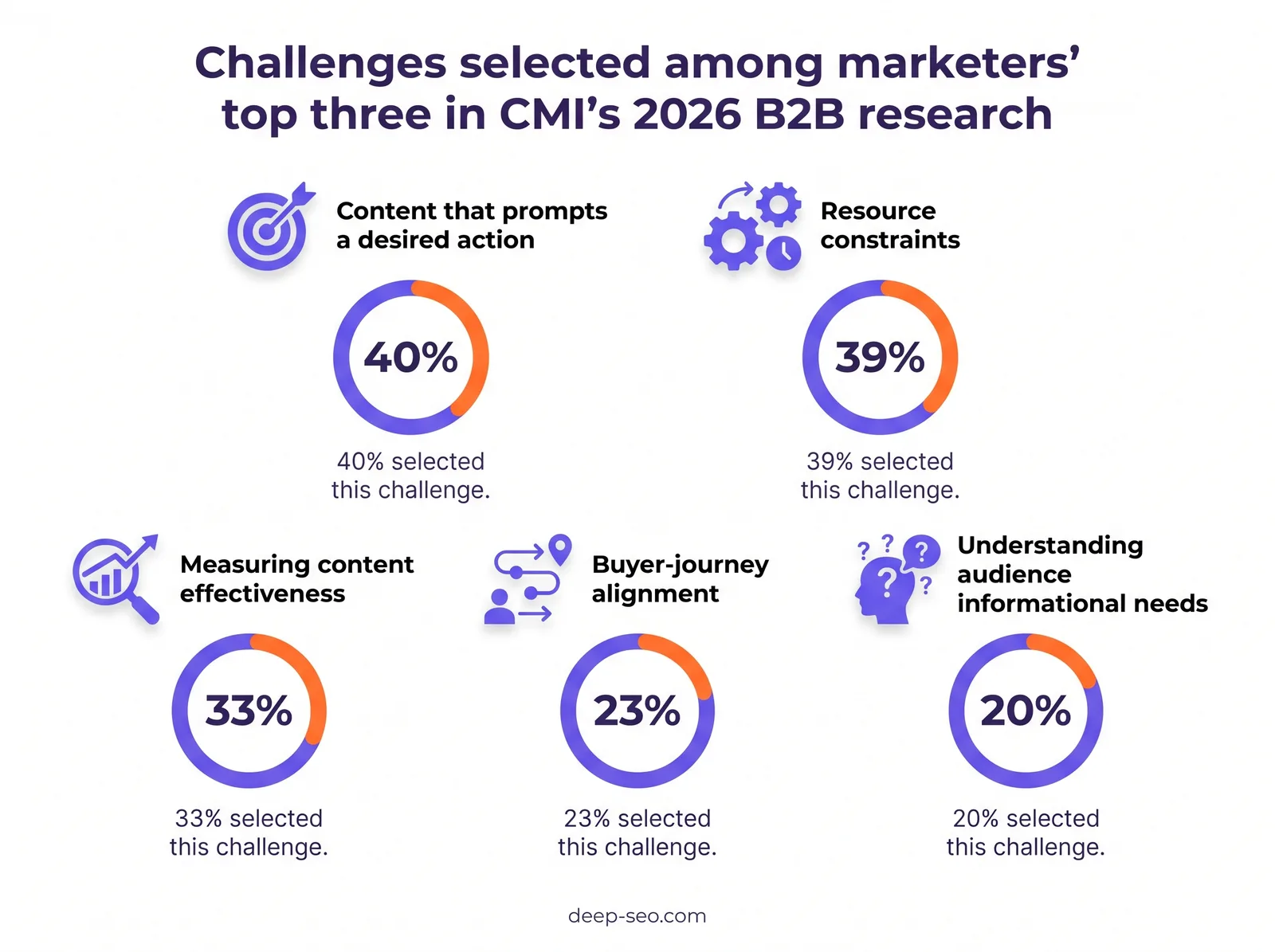
In CMI’s 2026 B2B research, 23% of marketers named matching content to the buyer’s journey among their top three content-marketing challenges. Understanding the audience’s information needs was a top-three challenge for 20%.
Don’t treat search intent as a buying stage. Intent describes the likely purpose of a query, but it doesn’t tell you exactly how ready someone is to buy. Someone making a comparison search may be an active buyer or still doing early research.
Turn assumptions into a planning worksheet
Before you approve a topic, complete these fields. The example uses an accounting software firm; you’d still need to check demand and buyer needs rather than treat the entries as evidence.
| Field | Example |
|---|---|
| Audience | Finance managers at growing firms |
| Problem | Unsure when to replace spreadsheet reports |
| Buying stage | Exploring options; not yet confirmed |
| Business goal | Attract relevant product enquiries |
| Next action | Use a reporting-needs checklist |
| Evidence to check | Interviews, sales questions, support requests, and search data |
The checklist should help readers assess their needs before asking for a demo. Check whether the evidence supports the problem and proposed action before you select keywords that match the need.
How do you turn search intent into a topic and page map?
Turn search intent into a page map by checking current results and grouping queries around the task they serve. Give each group a suitable page, whether existing or new, and plan links between related tasks. Separate pages are worth creating only when the needs call for distinct answers.

Check results before assigning intent
Look at which page types appear and how deeply they cover the topic, then check the questions they answer. You may see guides alongside comparison pages, with product pages in the mix too. Keyword-tool labels are clues; don’t let them make the decision for you.
Check for AI Overviews on commercial queries, not just questions. Semrush studied more than 600,000 U.S. desktop keywords across 10 industries. It found that the share of commercial-intent results showing AI Overviews grew 71% between November 2025 and April 2026.
That’s relative growth in the share, not a percentage-point increase, and it doesn’t tell you whether an Overview will appear for a specific search. When you check results, record:
- The query.
- The date.
- The location.
- The device.
Map tasks to pages
If an existing page already serves the task, use it. Missing key answers are a reason to update that page, not necessarily to create another. A new page makes sense when the need has no suitable home.
Build topic clusters around a broad guide, often called a pillar page, and link it to useful supporting guides and comparisons. Product links belong where they help readers take a relevant next step.
For each query group, record:
- The likely intent and audience need.
- The best page type and target URL.
- Whether to keep, update, or create the page.
- The next action that would help the reader.
- Which pages should link to it, and why.
Treat these examples as starting points rather than fixed rules for every query:
| Intent | Reader’s task | Possible page | Focus | Next action |
|---|---|---|---|---|
| Informational | Learn or solve a problem | Guide or tutorial | Clear answers and steps | Use a related resource |
| Navigational | Find a known resource | Brand or resource page | Make it easy to find | Reach the wanted page |
| Commercial research | Compare options | Comparison guide | Fit, trade-offs, and evidence | Check product details |
| Transactional | Buy or sign up | Product or service page | Offer details and key concerns | Request a demo or sign up |
How should you prioritize SEO work?
Prioritize work that serves a clear audience need and business purpose. Compare tasks against your page map: check intent fit and current performance, then look for evidence gaps. Weigh the effort against any work that must happen first. Search volume gives you context; it shouldn’t decide the order.

In CMI’s 2026 B2B research, 40% of marketers named creating content that prompts a desired action among their top three challenges. Resource constraints followed at 39%, and measuring content effectiveness at 33%.
Those findings offer planning context, not a universal order for your work. You still need to judge whether the value justifies the effort and whether the evidence supports that choice.
Choose work with a clear reason
- Refresh a useful page. If a page attracts relevant visitors but leaves key questions unanswered, check whether clearer copy or better evidence would close the gap. Useful links may address it too.
- Fill a decision gap. Create a comparison or evaluation guide when buyers lack the facts they need to proceed. Confirm that experts and sources are available before you commit.
- Defer a weak fit. High search volume alone doesn’t justify a topic. Revisit it if audience research shows a useful link to your offer.
Explain each roadmap choice
A keyword and deadline aren’t enough for a roadmap entry. State why the work matters and what action it should support. Name the owner, spell out any dependencies, and add a condition for checking performance.
A page refresh, for example, may depend on a product expert checking its claims, with the goal of supporting qualified enquiries. Before you change the page, record its starting performance and any tracking gaps.
Curious how your own site does? Run the free website check and RamradOS, our AI SEO assistant, picks it up from there. Start the free check →
How do editorial priorities become a repeatable production workflow?
Turn editorial priorities into a workflow with an owner and a completion test at each stage. Start with approval and briefing, then research before drafting. Review before publication and assess afterwards. Pause when intent or evidence is unclear, and schedule research and review time alongside writing so approval isn’t an afterthought.

Make the content brief a shared agreement
Build the brief from your page map. The writer and editor need to agree on these points before drafting starts:
- Reader and intent: Who is the page for, and what main question must it answer?
- Useful contribution: What insight or explanation will it add? What evidence will it contribute?
- Outline and sources: What structure should it use? Which claims still need research?
- Links and action: Which related pages help the reader? What next step fits the task?
- Approval rules: How will you judge accuracy and completeness? What else must be checked before publication?
Assign owners and plan capacity
Give each task a clear owner, even when the same person handles several roles:
- Research
- Writing
- Expert review
- Editing
- Publishing
- Performance checks
Use the capacity limits discussed in the priority section to set the schedule. Allow time for expert access and approval, not just drafting. Record decisions as you go so writers don’t have to guess why a change was made.
Set checks before drafting and publishing
Ready to draft: Confirm that the topic is approved and the intent is clear. Essential sources must be available before writing starts. If the brief is incomplete, send it back for more work rather than asking the writer to guess at what’s missing.
Ready to publish: Get approval from the required expert and editor. Check claims and links against the brief, then confirm that the next action fits it too. Assign the later performance check to a named role before publication.
Optional service support
You can assess Deep SEO’s AI Content Engine as a service option against this workflow. Use these criteria:
- Brief requirements: can your team define the audience and intent? Can it specify the scope and required evidence?
- Source checks: who verifies that citations support the claims?
- Approval controls: can unresolved questions stop publication?
- Editorial ownership: who approves the final text and owns later updates?
These criteria are for evaluation; they aren’t verified claims about service features. Your team should retain final decision-making authority.
What is SEO-friendly content?
SEO-friendly content gives people clear, accurate information so they can complete a task, while helping search engines understand the page. Your titles and headings should make the answer easy to find, with relevant links where readers need them. Accuracy and task completion matter more than repeating a target phrase.

Among B2B marketers who rated their marketing effective in CMI’s 2026 research, 65% named content relevance and quality as a contributor to improved effectiveness. That’s a reported contribution, not evidence that a specific change will improve your results.
Check each page before it goes live
Before you publish, check the draft against these questions:
- Does it meet the need? Answer the main question, then cover useful follow-up questions.
- Are titles and headings honest? They should describe what the page actually delivers.
- Is it easy to read? Keep paragraphs short and language plain. Use lists where they make the information easier to follow.
- Do links help? Give readers access to supporting facts or deeper guidance. Link to relevant next steps, too, using descriptive text. Check that each destination is accessible and relevant.
- Are visuals accessible? Give informative images useful alternative text, and explain key chart findings in nearby text.
- Does the next action fit? Offer a step that suits the reader’s task, not just your sales goal.
Plan links around the task rather than adding them as an afterthought. Your topic and page map should guide page relationships; use the content brief checklist to give the writer clear link requirements.
Make answers clear for readers and AI systems
In Pew Research Center’s March 2025 browsing study, 60% of Google queries beginning with question words such as who, what, when, or why produced an AI summary. You can’t use that finding to predict what will appear for every question.
Put direct answers near the headings they address, and name products and organisations clearly so readers know what you’re referring to. Link factual claims to their sources. Where shared criteria help people weigh options, use a comparison table.
These practices can make content easier to understand, but they don’t ensure rankings or AI Overview inclusion. Citations from systems such as ChatGPT aren’t assured either.
Can ChatGPT write SEO content?
Yes. ChatGPT can help you draft and edit SEO content, but you’ll still need human checks. Fluent writing doesn’t prove expertise, just as a citation doesn’t prove a claim is true. Give it bounded tasks and evidence to work from rather than treating it as the authority on accuracy or what your audience needs.

Give ChatGPT a bounded task
Start with an approved brief and supplied sources. You can ask ChatGPT to test outline options or put ideas in a clearer order, then tighten the sentences. Be explicit about what must stay unchanged: technical terms and quotes, for example. Protect product details too.
Leave intent decisions and original insights to people who know the audience and subject. ChatGPT can help express an expert’s view, but it shouldn’t invent one. Customer stories and supporting evidence must come from your sources.
Make the handoff clear
Give it the audience and source material, along with your brand rules. Spell out which claims to avoid, then check the work:
- Set evidence limits: Ask it to flag missing support rather than fill gaps.
- Open every citation: Check that the source exists and actually supports the claim.
- Check the final text: Recheck meaning and facts after edits, not just before them.
- Assign approval: A responsible editor or subject expert must resolve open questions before you publish.
Assess production support separately
Use the ownership and approval checks set out in the production workflow.
How should you measure and refine an SEO content strategy?
Measure your strategy against its goal, not how much you publish. Track search visibility and relevant visits, then look at useful actions and business outcomes where tracking allows. Review individual pages alongside topic clusters so you can decide which content needs work and what no longer belongs.

Connect reports to the page’s job
An enquiry page needs relevant enquiries, not just visits. With support content, look for signs that readers solved their problem. Time on page can offer clues, as can other engagement signals, but neither proves satisfaction.
Keep production activity separate from value: published articles and completed briefs tell you work is moving. They don’t tell you whether that work helped readers.
Use a shared performance template:
- Page job: Define the reader’s task and the business goal. What useful action should follow?
- Baseline: Starting performance and the period used for comparison.
- Results: Record visibility and relevant visits. Include actions and business outcomes you can reasonably link to the content.
- Limits: Flag missing events or unclear attribution. Say when there’s too little data.
- Decision: Specify the proposed change and its owner, then set a condition for checking again.
Account for changing search behaviour
Pew Research Center studied browsing activity from 900 U.S. adults in March 2025. Traditional search-result links received clicks on 8% of visits with an AI summary, compared with 15% without one.
That observation doesn’t prove AI summaries caused fewer clicks, and you shouldn’t treat it as a universal current click rate.
Track sampled AI Overviews and ChatGPT responses separately from ordinary traffic reports. Record each query with its date, along with any mentions or citations you see. You’re collecting limited snapshots, not complete measures of AI visibility or business value.
Turn findings into decisions
Set a check-in schedule that fits your capacity and the useful data available. A recent change needs enough evidence before you judge it. Improve weak answers; when pages serve the same task, consider merging them. Pages targeting the wrong need require a change of focus. Before retiring content, check its remaining role and the effect on related pages.
Record what changed and why, then feed those lessons back into your roadmap.
Read more
Frequently asked questions
Should you update an existing page or create a new one?
If a page already serves the reader’s task, update it when the information needs correcting or expanding to be useful. A new page makes sense when a distinct need has no suitable home. Before you decide, check your existing pages against current search results. A different keyword alone isn’t a reason to create another page.
What should be in an SEO content brief?
Your brief needs to tell the writer what to deliver. Include:
- The audience and search intent
- The main question and target topic
- The page’s purpose and outline
- Sources and internal links
- A useful next action for the reader
- The page’s distinct contribution
Flag unsupported claims that need resolving, and spell out the approval requirements so the writer knows who must check the page before publication.
Who owns the strategy when several teams contribute?
Choose a lead with authority to settle disagreements over goals and scope, including what takes priority. Evidence can come from several teams:
- Sales
- Support
- Product
- SEO
The lead keeps the plan consistent and records decisions, but task owners remain responsible for their assigned work.
What should you do when there is too little data to judge a page?
Don’t call the page a success or failure yet; record what’s uncertain. Check that tracking works, then review the page’s intent fit, accuracy, and links for clear defects. Keep your test focused while you gather more relevant evidence. You need that evidence before making a major change.
When should a team pause production?
Pause if a key source is missing, the page’s purpose is unclear, or required reviewers lack capacity. Before you restart, fix the brief or reduce the scope. Pushing a weak draft through just to meet a date can leave you with more work later.
Key takeaways
- Start with the reader’s task. Each topic needs a business purpose, too.
- Check your page map first. Look for an existing page that fits before you add another.
- Be clear about ownership. Assign responsibility for decisions, not just production tasks.
- Check claims consistently. Human and AI-assisted drafts need the same checks on their evidence.
- Let outcomes shape priorities. Use performance findings to decide what deserves attention, rather than just filling the calendar.
Compare your current roadmap against these principles, then choose a focused improvement to your SEO content strategy. Give someone clear ownership of that change.
See what this means for your website
Start with the free check. RamradOS explains the results and, if it fits, our AI Content Engine goes deeper.
Check your website free — in one minute
Our AI platform reviews your site and shows what to fix first. Our SEO team can implement it for you.