
Quick answer: Podcasts and webinars are audio or video formats that can support off-page SEO through guest appearances and collaborations. Sharing useful expertise with relevant audiences can earn editorial links from show notes or event pages and attract referral traffic. Participation alone does not guarantee backlinks, higher rankings, or increased search visibility.
Key facts
- Links help Google discover pages and assess relevance; an appearance or backlink does not guarantee a ranking improvement. Link best practices for Google
- Show-note and webinar-page links should use HTML <a> elements with href attributes. Link best practices for Google
- Paid placement links should use rel="sponsored"; Google also accepts rel="nofollow". Qualify your outbound links to Google
- E-E-A-T is not itself a specific ranking factor. Creating helpful, reliable, people-first content
TL;DR: Choose audience-relevant appearances, contribute useful expertise, offer a genuinely helpful destination for listeners, and measure editorial links and qualified visits rather than promising ranking gains.
- Podcast
- An episodic audio or video program typically available for on-demand listening or viewing.
- Webinar
- An online presentation, workshop, or discussion, often delivered live with audience interaction and made available afterward.
- Show notes
- The written companion to an episode, usually containing a summary, guest details, and links to resources discussed.
- Guest appearance
- Participation as an invited expert on another organization’s podcast or webinar.
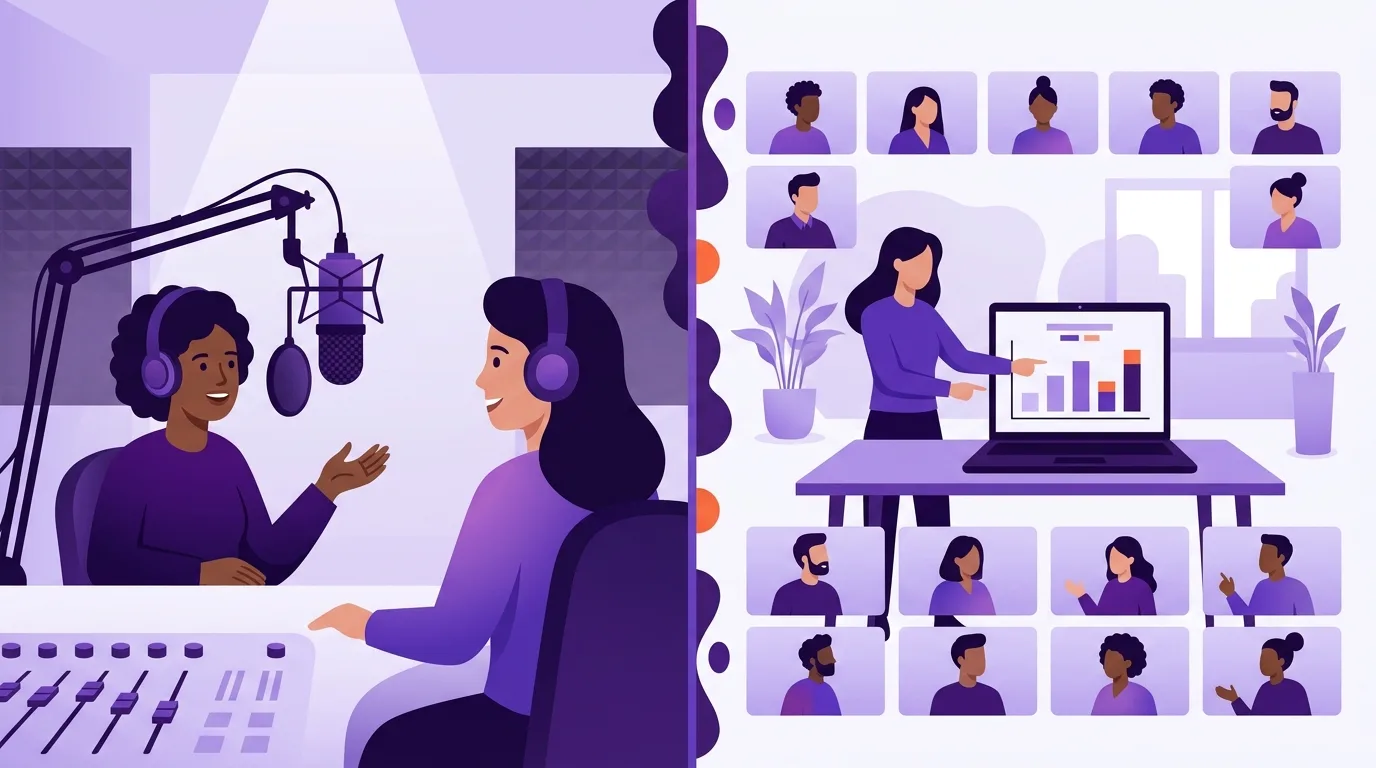
What are podcasts and webinars in off-page SEO?
Podcasts and webinars can support off-page SEO when you appear on another host’s show or work with a partner. Podcasts usually offer episodes for on-demand listening or viewing. Webinars are talks or workshops that often include live discussion. Both can put your work in front of a new audience and may earn editorial links or referral visits.
Video podcasts let viewers see the discussion. Recorded webinars let people watch later, though they can’t join the original live session.
What counts as off-page activity?
The off-page part happens beyond your own website. You might join a podcast as a guest or co-host a webinar that a partner shares with their audience.
Publishing a webinar on your own site isn’t off-page SEO by itself. Outside coverage and links from host pages provide that part. Compare content formats based on what your audience needs and what you want to explain.
How can appearances help SEO without promising rankings?
A useful guest session can introduce your expertise to people who haven’t heard of your business. A host may link to a resource in the show notes, and interested listeners may visit your site. Neither outcome is assured.
Offer a resource that answers a question raised during the session. Hosts decide whether to link to it. Some listeners may type a spoken URL rather than click, so not every visit will come through a backlink.
Google can use backlinks to discover pages and assess relevance, according to Google’s link guidance. Don’t treat each new link as an assured ranking gain.
Audience trust isn’t a Google authority score. E-E-A-T isn’t itself a specific ranking factor, as Google Search Central explains.
Don’t treat attendance or social engagement as proof of a ranking benefit. For the broader relationship between social activity and search, see social media and SEO.
Find relevant hosts and pitch an audience-first topic
Choose hosts whose listeners face a problem you can help solve. A large audience isn’t much use if your topic doesn’t fit. Your content strategy can guide that choice.
Build a qualified prospect list
- Find active hosts. Search podcast platforms such as Apple Podcasts or Spotify. Topic searches on Listen Notes can uncover specialist shows; industry associations are a useful place to look for webinars.
- Review recent work. Listen to an episode or watch a session. Check whether the host covers questions your audience asks and gives guests room to explain their answers.
- Inspect public pages. Look for useful show notes and guest resources. Follow the host’s booking instructions rather than sending the same pitch to every contact.
Keep a prospect sheet with these fields:
- Host and intended audience
- Proposed topic
- Relevant episode and its public URL
- Booking contact
- Outreach status
Send an audience-first pitch
Connect a real episode to a question the host hasn’t yet answered. Use verified details and your actual experience:
“Hi [name], your episode [title] explored [specific point]. Could a follow-up answer [audience question]? I’ve [relevant hands-on experience] and can share what that work involved. I can offer [useful resource] for listeners too. Would this fit your show?”
Prepare the session and a useful listener destination
Pick the question you want listeners to be able to answer after the session. Then prepare an example that makes your advice easy to follow.
- Prepare your contribution. Match the host’s style. Gather evidence for your claims and send a short biography that reflects your relevant experience.
- Agree on the format. Confirm the session length and how audience questions will work. Get permission to record or reuse the session before making plans for clips.
- Set webinar roles. For an owned or co-hosted session, agree on each speaker’s part. Decide whether registration is needed and who will publish the recap.
- Choose a useful destination. Use an existing resource if it fits. Create a new listener page only when it offers something distinct, not a copy of pages for other appearances.
- Keep the closing invitation brief. Choose a web address that’s easy to say aloud. Use clear call-to-action design so listeners know what they’ll find.
Say you run an online furniture shop and join a webinar about choosing a sofa. A guide to measuring doorways and stairwells gives listeners a useful next step. A generic homepage leaves them to find that advice themselves.
Partners still need an editorial reason to recommend your resource; hosting the session alone isn’t enough.
Coordinate show notes, publication, and follow-up
Send the host the resource URL you discussed, not a bundle of unrelated sales pages. Make it easy to publish accurate notes while leaving link placement and wording to them.
- Supply guest details. Send your preferred name and a short biography.
- Summarize the session. Describe what you actually covered, rather than reusing the original pitch if the discussion changed.
- Ask about resource links. Request links to material mentioned during the session. Don’t demand keyword-heavy wording.
- Check the live page. Test the resource link and check the guest details. For example, make sure a link labelled “sofa measuring guide” opens that guide rather than your shop’s homepage.
For public show notes, suggest HTML anchor elements with href attributes and clear link text. Google generally can’t reliably extract links in other formats, according to Google Search Central. Don’t assume an app-only description or spoken URL provides a crawlable link. See outbound links for implementation advice.
Plan for web accessibility before publication. Transcripts are a WCAG Level A requirement for prerecorded audio-only content, including podcasts, under W3C’s transcript guidance. For video with audio needed to understand the content, captions are Level A for recordings and Level AA for live broadcasts, under W3C’s caption guidance.
Thank the host and send any corrections. If you have permission to share excerpts, link back to the original session. See content promotion and distribution for broader sharing options.
Common mistakes that waste appearances or create risk
A poor audience match can waste your time before the recording even starts. Paid-link terms and unsuitable markup need a separate check.
- Chasing volume over fit. Choose hosts using the audience checks above.
- Turning the session into a sales pitch. Answer the question with a practical example instead of repeated product mentions.
- Sending listeners to an unrelated page. Use the listener-destination approach above.
- Skipping publication checks. Follow the live-page checks above.
- Treating paid slots as ranking credit. Paid or sponsored links should use rel=”sponsored”; Google still accepts rel=”nofollow”, according to its link qualification guidance. Buying links for rankings is a separate risk. Excessive link exchanges and contracts that stop publishers from qualifying links can also breach Google’s spam policies. See link spam and penalties for more context.
- Confusing registration with public access. A registration page doesn’t make a hidden recording or transcript public. Consider a useful public recap and check its indexability.
- Expecting markup alone to earn search features. Schema.org’s PodcastEpisode describes an individual episode within a podcast series. For video podcasts and webinar recordings seeking video features, Google recommends dedicated watch pages whose main purpose is viewing one video. Online-only webinars aren’t eligible for Google’s event experience because its event guidelines require a physical location. See structured data for implementation details.
How do you measure results from each appearance?
Compare relevant visits and inquiries with the time you spent preparing. Keep those audience responses separate from changes in your page’s search performance.
Keep an appearance log
Record the details you’ll need to judge whether a similar session is worth doing again:
- Publication date and host-page URL
- Linked destination and any link qualification, such as rel=”sponsored”
- Referred visits and relevant inquiries
- Preparation cost, including staff time
Use the publication checks above. Backlink tools such as Ahrefs can help you find other mentions, but don’t treat them as a complete or instant record.
See the earlier distinction between links and ranking gains.
Separate referrals from search outcomes
Referral traffic comes from the partner page. Organic search traffic comes from search results that lead to your own resource page.
Use consistent UTM parameters for clickable links in campaign tracking. Spoken URLs and copied links may lose attribution, so your reports may not capture every visit from an appearance.
In Google Analytics 4, check referred or tagged visits alongside meaningful key events, such as an inquiry. Visits alone may not tell you whether the audience was a good fit.
As with other SEO attribution, later ranking changes or branded searches don’t prove that the appearance caused them. Use the responses you can trace to help choose future hosts and topics.
Frequently asked questions
Which page should you ask a podcast or webinar host to link to?
Ask for a link to the resource that best answers the question discussed in the session. If you talked through a practical task, a relevant guide is usually more useful than your homepage. Send the exact URL and a plain description of what listeners will find. The host decides whether and where to include it.
Can a podcast appearance still be worthwhile if the host does not link to your website?
Yes, if the audience is relevant and you have something useful to share. Listeners may get to know your work even without a clickable link. You may also be able to reuse parts of the discussion with permission. Judge the opportunity by audience fit, not just the chance of a backlink.
Can you turn a webinar recording into a podcast episode?
Yes, if the discussion makes sense without its visuals and you have permission to reuse the speakers’ contributions. Remove housekeeping and explain any essential charts in words. Replace instructions that depend on slides, then add a short introduction for audio listeners. Follow the transcript guidance above when publishing the audio version.
Do you need to run your own podcast to get invited onto other shows?
No. Being a guest means contributing to someone else’s show, not hosting your own. Pitch a topic you know well and explain why it matters to that host’s listeners. Relevant work or speaking samples can give the host a clearer sense of what you’ll bring.